Spring on the River

One of the really nice things about my stretch of the French Broad River Greenway is that it is often populated with people enjoying it. I have seen people slack-lining there; slack-lining is walking on a line tied between two trees. People also lie out in the grass and in hammocks. Lots of people walk, jog, roller-skate, and bike along the path. There are many dogs accompanying their humans. People fish on the river as well. Occasionally, people will swim or put their feet in the water. It is heavily enjoyed, especially in the summer.

Yesterday evening, I walked the stretch and saw many other people enjoying the area as well. One man was blowing huge bubbles. It was a really nice sunny evening. I noticed that there were few non-human animals around or at least visible. I saw a few Carolina Chickadees, which I particularly like. They are such cute little round birds with a black head.

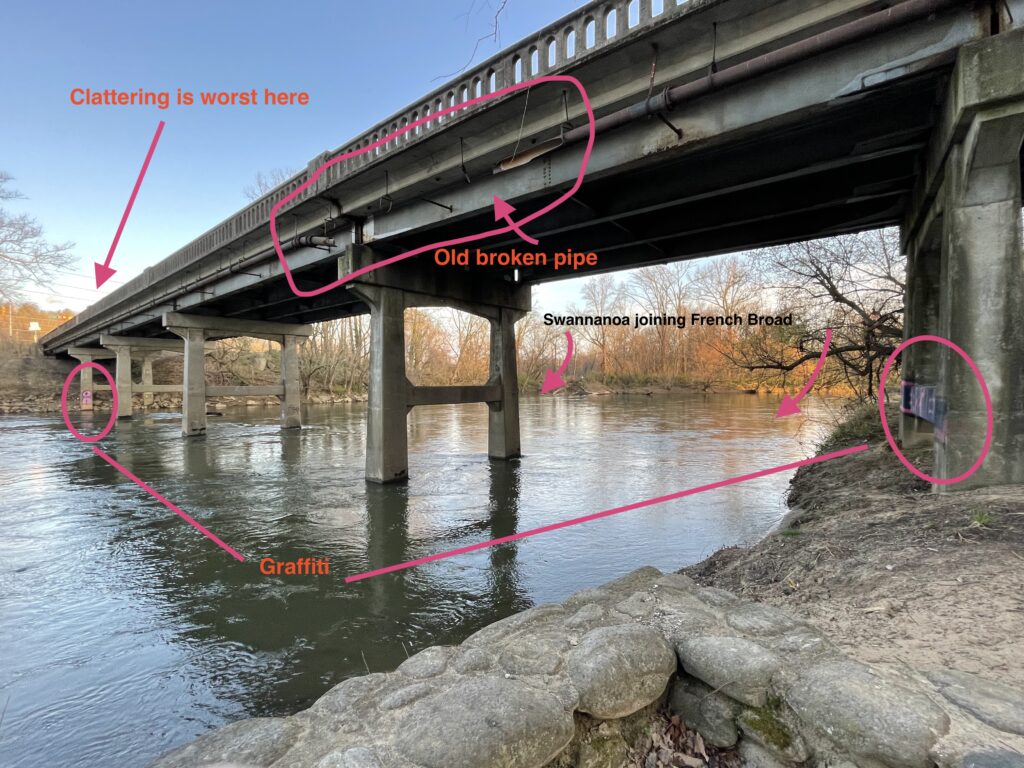
This stretch of the greenway has a strong feeling of human to it. It is not like hiking in the woods where animals are encountered much more. It is also unlike a heavily maintained park with man made fountains. It has a feeling of being old and used. It is reasonably clean and kept since it is very visible and used, but it is not impressive. With rain, there is a lot of mud. The plants are wild and made up of mostly old and gnarly trees. There is also quite a bit of graffiti on the signs, under the bridge, and on the sewer manholes. Most of the man made stuff, like the signs, path, parking areas, bridge, manholes, and benches feel old and industrial. They feel structurally intact but also tired. The bridge is quite old and has parts on it that make loud clattering noises when cars cross.
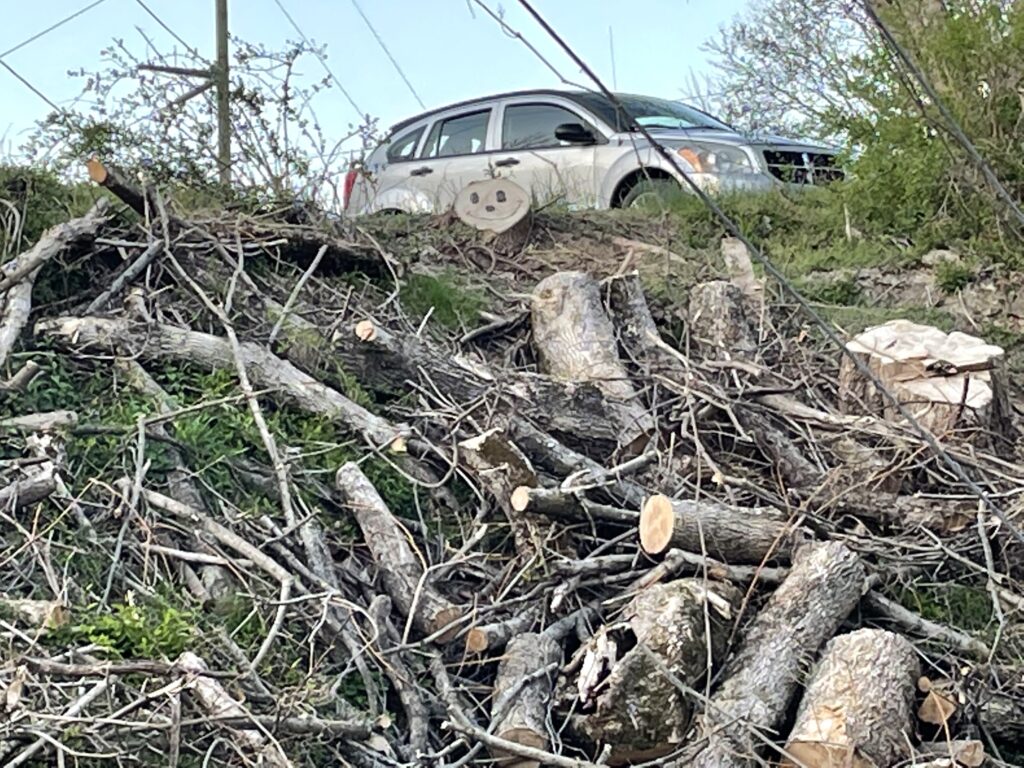
Destruction of trees along the path, but it’s okay since someone drew a smiley face on a log (sarcasm). Not sure why these trees were cut down, maybe they were old, maybe for power lines, maybe for nearby construction.
The old bridge with some important notes.

My section of the greenway has a feeling of being old, unkept, and industrial. It has a feeling of nostalgia and wonder about what and who all has been there before. It feels old, like it needs to be redone and cleaned up, but does it really? If it gets “cleaned up” and redone, then it will lose its history and create a whole lot more erosion from the construction. It has a level of familiarity to it now that I would not want to see taken away if it were redone. I think there are parts of it that could be improved, but I do not think it should be wiped clean and redesigned to be more attractive to the human eye. It needs some improvements in drainage, right now there are a lot of deep dirt ditches for water to go through when it rains, but they are not very efficient or sturdy. They will simply wash away with the rain water. The manholes could use some improvement, not necessarily taken away, but rebuilt. Some are quite dilapidated and the rocks that were surrounding them have washed away. Some of the graffiti should probably be painted over because they are rude and negative political statements.

I would expect some work to be done on this section in the next few years because the greenway, further down, has been receiving plentiful construction and improvement. There are plans to continue it down below the section I have been writing about. It seems to make sense that the city would want the whole greenway to be well kept and have a similar feeling to it. I will be interested to find out how they might improve or change my section. Hopefully, not in an aggressive way, but just some little improvements.
Destruction and Protection

Nature is slowly being taken away from us. By our own hands we have destroyed the earth with such things like suburbs, shopping centers, and skyscrapers. We have been frivolous with our earth, treating it as it does not matter. But Pinehurst Arboretum has sent out to restore the earth, yet it can only do so much.

Pinehurst Arboretum is surrounded by development. First the Village of Pinehurst City Hall was built, but afterwards development was halted for fear of such destruction of earth. Now after more than a decade of protection, destruction has once again taken hold.

Houses were the first to arrive, not directly on Arboretum property, but close enough to be considered pollution. One such house, a new build, has been dubbed, by my mother, as the “McMansion” for its tacky and expansive style compared to the quaint cottages that previously surrounded the area. Along with houses is the new apartment building named “The Greens at Arboretum. It is a large three story building that is an eye sore to the community. Instead of being immersed in nature when at Pinehurst Arboretum, you stare at the top floor of The Greens. Worst part though is the runoff from local sewers are transported to Pinehurst Arboretum.

With all of this pollution I decided to do my own experiment, not in sight or smell, but in sound. Inspired by Gordon Hempton from “Silence Like Scouring Sand” I observed the sound of Pinehurst Arboretum. Specifically whether or not the majority of sound is human made or made by nature.

For my experiment I went to three different locations, called Sites, in Pinehurst Arboretum. I wrote down every noise, human or natural, I heard within a five minute time span. The sites are far enough apart to get different sounds depending on the location of each site. The sites experimented with are #1 Joyce’s Meadow, #2 The Creek and #3 Longleaf Pine Savanna.

Site #1, Joyce’s Meadow experienced the most sound but unfortunately was almost all human made. In the five minute time span from 4:33 to 4:38 there was only one sound at this entire site that was natural, a bird singing. Human sounds were abundant at Joyce’s Meadow, including dogs barking, a remote controlled car, kids riding on bikes, music playing from a phone, and highway traffic. I included dogs barking as human noises because they accompanied humans in Pinehurst Arboretum.

Site #2, the Creek did have less human sounds but still almost no natural sounds. From 4:45 to 4:50 I observed the creek and the only natural sound was the wind whistling in the trees. Other sounds included a rattling stroller, the sound of bikes going over a wooden bridge and gravel, kids yelling and again highway traffic.

Site #3, Longleaf Pine Savanna did not have an increase of natural sounds, but the site is further away from human inhabited areas so it feels less like it has human intrusion. Yet, it had human sounds mostly from far away on the highway, cars and loud motorcycles can be heard even when the highway is far from the Longleaf Pine Savanna. All of these sounds were observed from 5:03 to 5:08 and the entire time the cars on the highway were background noise.

All of these observations are important because it shows that in Pinehurst Arboretum it is impossible to have complete silence and be completely immersed in nature. Even if there is no human noise within the confines of Pinehurst Arboretum, the highway nearby has constant traffic so noise is always near the Arboretum. It detracts from being able to hear nature because every other sound is what you focus on as opposed to a bird that is singing. 

When going to a natural space, you can’t control other people’s noise but you can control your own. And when going into a natural space like Pinehurst Arboretum try to experience nature making as little sound as possible to see what nature would really be like without human interference.

Aging Unexpectedly

Journal entry for 2/21/2021

As far as foresters go, Peter Wohlleben is a rockstar, both in terms of renown and controversy. Some (especially those in the hard sciences, of course) find his teaching of forestry concepts through whimsical anthropomorphization childish. Like many of the 2 million-plus people who bought his breakout hit The Hidden Life of Trees, his prose was deeply affecting to me and has certainly altered my engagement with the sylvan world.

Trees, more than nearly any other organism, are marked by their longevity. According to Wohlleben, “One reason that many of us fail to understand trees is that they live on a different time scale than us.” (The Hidden Life of Trees vii) The oldest tree on the planet is well over 9,500 years old. Bristlecone pines that anchor the ridges of the Sierra Nevada regularly reach 5,000 years. Oaks and Beeches average ages in the 300’s and coppicing can extend their lives into the low thousands. (UCSB Science Line) In the Guilford woods, a well-known Tulip Poplar has gracefully aged into its late 200’s. 

“Creatures with such a luxury of time on their hands can afford to take things at a leisurely pace,” remarks Wohlleben. (The Hidden Life of Trees vii) But what happens when trees aren’t allowed to move and grow at their usual incremental crawl? How does the forest, the land, the air–the walk through the woods–change when the trees have had an unorthodox upbringing? 

The Loblolly that reside on the 10 acres that serve as my habitation spot have had a markedly different relationship with aging than their neighbors in the mesic mixed hardwood and dry Oak-Hickory communities that compose the rest of the Guilford woods. (Guilford College Woods Assessment 27) Most of the Guilford woods were farm fields until the 1940’s, save for a few small stands and select trees that avoided felling through the late 1800’s and early to mid 1900’s. Just as many of the trees that now make up the Guilford woods were beginning to take root in the mid-1900’s a large tract in the northeast began to be used as a pine plantation. The Loblolly stand that exists today is the remnants of that plantation. 

While the trees outside of that stand have been allowed to grow unencumbered since Guilford’s fields yielded to forest, the pine stand was grown with the sole intent of being harvested. The rest of the woods is, more or less, a natural forest that has developed through the standard stages of forest succession. The pine stand was planted and saw no competition from other species. It has progressed as humans intended, not as the Loblolly, or any of the other trees would’ve had it. 

Recently, this has led me to wonder about the effect this history has on the sense of place of the pine stand. Are forests that never would’ve existed without human interference lesser than those that progressed naturally? I can’t help but think of the pine stand as akin to a hog escaped from a slaughterhouse. What are you to do after you’ve avoided the saw? Are the Loblolly’s seeking purpose they never had? 

At first, I wondered if the pines might’ve missed the companionship of other tree species. As I’ve looked into Loblolly behavior, though, I’ve learned that, especially in open fields, fast-growing softwoods tend to group together. The Guilford Loblolly are a particularly interesting bunch because, unlike most forests, nearly all of them are the same age. Having been planted in the 1940’s, the trees are reaching 80-some years of age. If they were still plantation trees, now would be an ideal time to harvest. They aren’t and they won’t be, though, and, if economic or environmental factors don’t drop them, they’ll likely stand at least another 40 years. Their lives and lifespans are radically different from the course set for them in the early 1940’s. 

I have written in my first entry of how the pine forest is distinct from the other parts of the woods. It’s quietness is enchanting to me. For the first month or so of the semester, I visited every time I walked in the woods, usually two or three times a week. After I first learned that the pine stand is not naturally occurring, I didn’t return for several days. My feeling in response to that knowledge bordered on disappointment. If the pine stand wasn’t natural in its origins, I wasn’t sure I could expect it to hold the power I had previously felt there. 

That was a misguided notion, I’m sure. I have a bad habit of pretentious idealism when it comes to land relationships. My more reasoned mind loves that the Loblolly were never intended to live long enough that I could see them. The intention with which they were planted is not the intention they hold today. Now that the Loblolly are growing and swaying into their 80’s, I wonder if there is some slow-moving realization crawling up trunks and through the overstory that the burden of production has been lifted, the intention has changed, and this stand will live another 40 years yet.

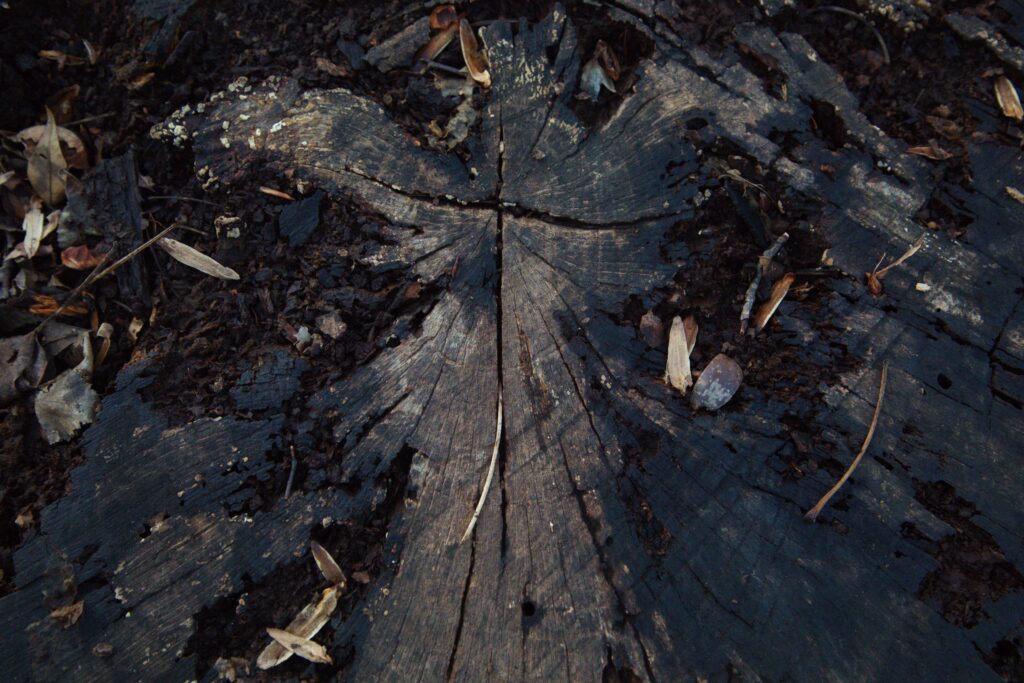
This is one of the few stumps I could find in the Loblolly stand that looks like it was felled intentionally. Considering the size of the stump, I wonder if this was some other tree felled before (or in preperation for) the planting of the Loblolly stand. I was struck by the cross that has appeared out of the cracks in the wood. For such a simple and widespread symbol, I feel like crosses don’t often show up in nature.

Winter Calling

Journal entry from 2/15/2021

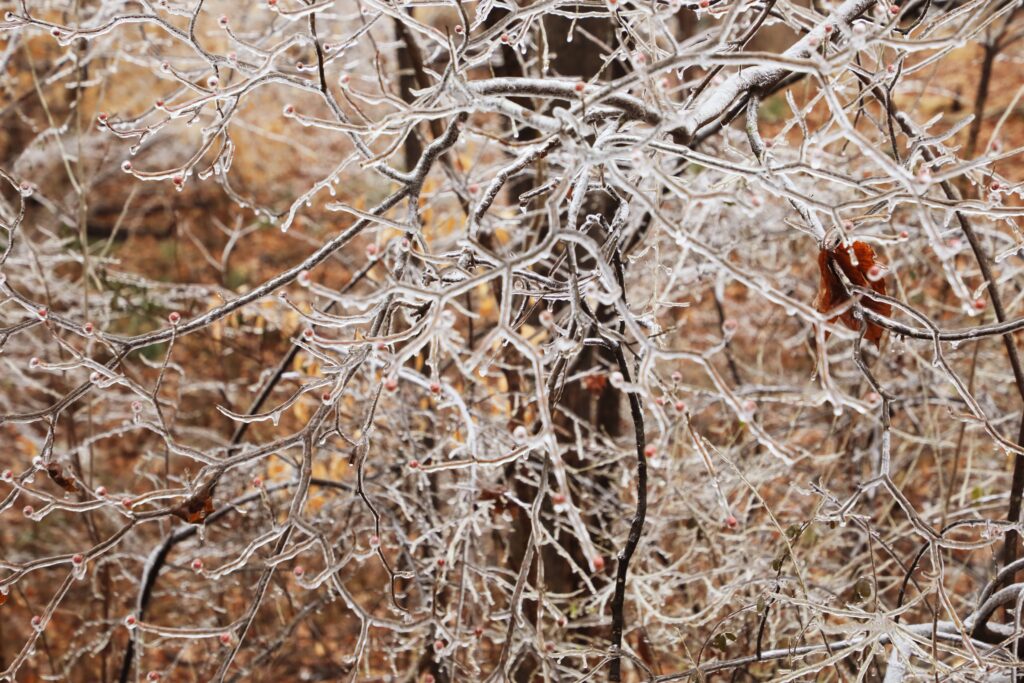
The light reflected through the frozen Loblolly needles casts the understory in greens and golds.

I have always felt best in school and life when I’ve had plenty of structure. I thrive when I can know something clearly through what I see, feel, hear and touch. When it comes to environment, especially, I appreciate knowing what’s coming. I think that’s why I like winter so much more than any other season. It is the most structured of the seasons in that it is visually and tactilely distinct in a way other seasons aren’t. Spring and summer share much of the same feelings–the brush of fresh grass, the smell of new vegetation–and in North Carolina, fall blends into summer with increasing ease. Winter has experienced the same seasonal blending phenomena as the planet has warmed and weather systems have destabilized. But, when I feel frost crunch under foot when I step outside, or when I can feel the cold creep of Raynaud’s disease reaching down my fingers, even with the thickest mittens, I know it is winter. That knowing feeling is driven to my core whenever I wake up and see fresh snowfall. I will always love new snow because it so radically alters the landscape yet offers a deep environmental–and seasonal–certainty. If there is snow then winter is not entirely gone. I know that it is winter because I can see that it is winter and I find great comfort in that proper seasonal presentation. 

I didn’t get nearly enough snow for my liking growing up in DC, and I’ve gotten even less since moving south to Greensboro. In the two and a half semesters I’ve spent at Guilford I haven’t seen any measurable snowfall. By mid February of this year, I had resigned myself to the fact that I was likely to face a winter without snow (is it even winter at all?). When the breakdown of the gulf stream-induced ice storm hit North Carolina, I figured I could accept a smattering of ice and snow as a consolation prize. 

I woke that morning to glistening trees and no power, which I didn’t realize until I was met with a cold shower and no heat after a wet, chilly romp in the woods. After seeing the trees out my window festooned in ice I got outside as quickly as I could. Frozen things don’t last long in the south, and I didn’t want to miss seeing the woods frosty. I did not expect to be as affected by the beauty of the woods covered in ice as I was. I was especially struck after I got to my habitation journal spot in the Loblolly pine stand. 

About three years ago, I planned a short weekend backpacking trip with my friend Ellie on a stretch of the Appalachian Trail we had hiked numerous times before. It was a weekend in early February, and we both wanted a familiar, easy to plan trek. We figured the midwinter snow in the northern Appalachians would provide something new. We planned an 18 mile hike for our first day and 10 the second. At our normal pace, we would’ve had no trouble, but we didn’t account for the slowing effect of hiking through snow. We also didn’t realize just how cold it gets on Appalachian ridges in February. We stopped for a quick lunch in a hollow on our first day after hiking for a few hours. I pawed some trail mix and mint Clif bars out of my pack and we gnawed on our frozen snacks for a few minutes in silence. Then, nearly in unison, we looked at each other shivering and agreed that if we didn’t start moving we’d freeze. 

We didn’t stop for the next 12 miles and hiked with as much vigor as possible to keep and retain warmth. I don’t know if I’ve ever been more thoroughly chilled. I remember that as an incredibly unique and beautiful hike though, because every inch of vegetation was covered in a quarter to a half inch of ice. As the sun sank into the ridges to the west the ice reflected golds and silvers, and unexpected greens and blues, too. 

I never saw ice so completely envelop a place like that again until this winter’s ice storm in Greensboro. The Loblolly aren’t quite the same as the scrub pines that hug northern Virginia ridgetops, but when their needles are covered in ice they throw light in exactly the same way. The unexpectedness of that connection was both flooring and reassuring. The seasonal structure that I crave is not present in Greensboro, but when the visual and tactile markers of winter do visit, they are all the more powerful.

Places of Conviction

Journal entry from 2/3/2021

For context–I admittedly did not know how to post on the wordpress site until this weekend and have been recording all my entries in a google doc. This was my first entry from early February.

The Loblolly stand I have been observing

According to the stories you invariably end up hearing in small town bowling alleys in the midwest, turn-of-the-century loggers in the northern pine stands of Wisconsin and the Upper Peninsula of Michigan would refuse to sleep in a logging camp if any of its buildings had even a single stick of wood that wasn’t White Pine. I can empathize with that feeling even though my reasons are far less soaked in sweat and sap than those loggers. I have found that the most beautiful forests I have walked in have been White Pine forests. There is one stand in particular, near to where I last engaged in a habitation journal-style activity (I called it a phenology journal then) where the White Pines were never logged and exist as they were before nearly all the midwest was clear cut. My favorite spot lies two miles across the Michigan-Wisconsin border in the Sylvania Wilderness Area. There, the White Pines give way to Hemlocks on the banks of Loon Lake, whose waters are near black from the tannins leached by Hemlock needles. If you were to scoop up the water in a clear bottle, it would look like a strong cup of English breakfast tea. 

I think that each pine forest has a defining uniqueness to it in a way other forests don’t. I love the Beeches, Oaks, Maples, and Elms that populate the Shenandoah greenscapes I am most familiar with. They are lovely in their standardness. I know those forests, and I know that I can find similar forests with similar feelings about them in Western Maryland, or Pennsylvania, or North Carolina. 

But the pine stands are not so easily typecast. In Wisconsin and Michigan the character of those stands was a wonderfully mischievous wildness that felt much larger and more acute in its natural power than most other places. The first time I saw the deeply dark water of Loon Lake I thought of Sauramons tower in the Lord of the Rings: obviously dangerous, obviously powerful, but so, so beautiful. 

The pine stand in the Guilford woods possesses a similarly powerful character too, I think. I have felt that it boasts a quietness I’ve been unable to find anywhere else on campus, or in Greensboro at all, for that matter. For me, that quietness comes most directly from the ground. If you walk into the pine stand in the woods from a more deciduous area, you’ll notice a change underfoot. The ground–usually ruddy or muddy or rooty or rocky–changes to an enclosed softness. The first steps yield a sharp crunching feel, and you’ll almost unconsciously begin to walk more tenderly. A few paces in and you begin to get a sense for the point at which the needles break and give way to a softer depression. The ground is truly different in its composition. The rest of the woods offer bare soil, or soil under a thin layer of leaves and twigs. Under the Loblolly, though, there’s a good inch of gently browned needles and another two of humus before reaching dirt. 

The relative remoteness of the Loblolly stand adds to the quietness, too. Without a guide, the stand would be hard to find without prior knowledge of the woods. The main loop that the lake and North apartment entrances to the woods lead to does not directly connect to the pines. The lack of signage doesn’t help either, nor does the fact that the Loblolly make up just 10 of the woods 240 acres. While I consistently see joggers or dog walkers in the better-traveled sections of the woods, I rarely see more than one other person in the Loblolly. Perhaps this is because there are none of the usual landmarks that draw students to certain sections of the woods. There are no fire pits, no forts and no streams or ponds. Even the deer tend to just pass through the Loblolly on their way to someplace else. There is minimal ground cover due to the acidic humus and few young trees, leaving little for them to snack on. 

I love this quietness, and I love that it is confined to just a small corner of a small forest. The Loblolly, all of which were planted with the intent of harvest, would’ve never formed such a concentrated community in such a small area on their own. This stand is unnatural and it is individual and its uniqueness has lent it a distinct character. 

In some regards, the White Pine stand in the Upper Peninsula that I love and the Loblolly pine stand in the Guilford woods that I love could not be more different. One is old-old growth, never logged, never farmed. The other is as new as a mature forest can be. One is midwestern in location and climate, the other distinctly southern. Nonetheless, the two pine stands are tied by a powerful sense of character unique to pine forests. 

Recently, I was asked to identify what I look for in a friend for a class icebreaker. I thought about the question, and who I have chosen to surround myself with, and who I have sought to be surrounded by. I have long sought to surround myself with people of conviction, and I want to surround myself with places of conviction, too. At Guilford, the Loblolly stand is a place of conviction.

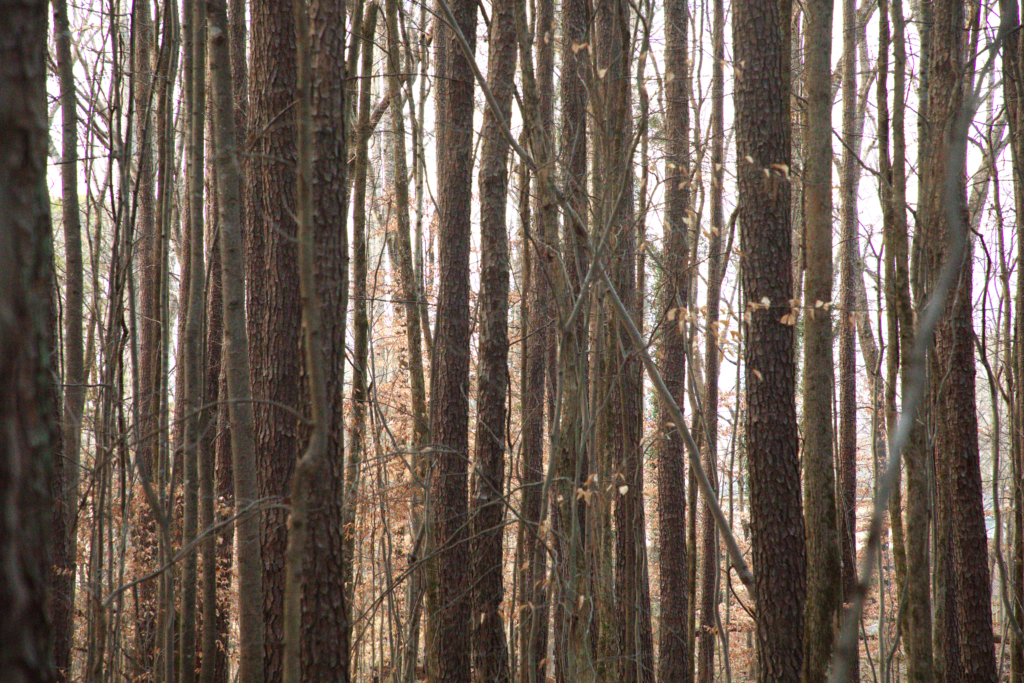
The Loblolly Stand, pictured above, carves through the rest of the more deciduous forest.

Parasites and Other Itchy Scary Things

3/21/21

Today’s blog post will be a comprehensive list of the parasites, animals and plants that cause humans to be uncomfortable during the warmer months. The minute it stops freezing and I’ve taken a hike in the woods, or layed in the grass for a little bit (a privilege I can enjoy only during the coldest days during the winter) I wake up to find my legs covered in red itchy bumps. If you’ve ever had a mosquito bite they look quite similar yet itch around 10x more, and for some reason arthropods love me just as much as I love them so I’m always the first to harbor the lovely chigger, a mite that loves the taste of humans. The itching lasts a week or two and there’s nothing that helps (clear nailpolish is a myth by the way), it just has to be waited out.

The second of the parasites are of course ticks. On Nisani Farm there are Lone Star Ticks, Dog Ticks, and deer ticks, some of which can be as small as a pin prick. From these kinds of ticks you can get lyme disease, rocky mountain spotted fever and Alpha Gal (a relatively new and increasingly more common protein mutation that causes allergic reactions to red meat after someone eats them, one reason why beyond meat burgers and impossible burgers have gotten so much more popular in rural virginia). To prevent ticks we have a daily regimen of tucking our pants into our socks before leaving to work outside, making sure the grass stays short near the house, and nightly complete body tick-checks. No one in my family has ever gotten lyme disease despite finding five ticks every day during the summer!

And parasites aren’t all! We also have horse flies that take chunks out of your skin, bald heads beware, mosquitos, and sweat bees who mean well but sting you when you accidentally squish them during the lunchtime meal of your sweat where they’ve crawled under your sleeve to indulge on.

We also have the dreaded poison ivy growing literally everywhere. Walking barefoot is never recommended. Poison ivy, or Toxicodendron radicans, is a three leafed plant that grows a hairy vine that is covered in an oil that causes a rash on most people. If you think you aren’t allergic to poison ivy youre likely mistaken and/or lying. We have had interns who had to go to the clinic from severe poison ivy rashes after insisting it doesn’t affect them. To prevent the onset of a rash dish soap immediately does the trick.

And among the venomous there are snakes and spiders. A beautiful black widow spider lives in every pot in one of our high tunnels. We leave them there because we have never had a problem with them and they help with pests, we’re just mindful of their presence! Their beautiful black shiny bodies contrast with the red, and their ballet-like movements gracefully make webs. 

We also have brown recluse spiders of which I have never seen hence their reclusive title. They can cause a lot of damage if they bite someone, for example capillary damage. 

Lastly we have snakes. We have lots of non-venomous species like the Eastern Black Rat Snake and Worm Snakes, Carphophis amoenus, a small brown smooth snake that likes dark cool crevices like under logs and rocks. Among the venomous there are Northern Copperheads, Cottonmouths and Timber Rattlesnakes. They usually stay far away from people but I have encountered them while hiking in the woods and when a juvenile Cottonmouth found its way into the living room.

And although not completely harmful, skunks and their sprays are frequent, and nothing gets rid of the smell, not even tomato soup.

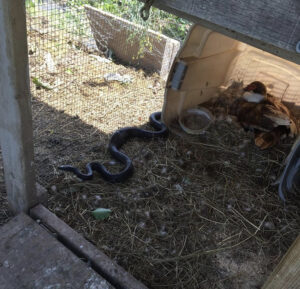
An Eastern Black Rat Snake emerging from the duck coop

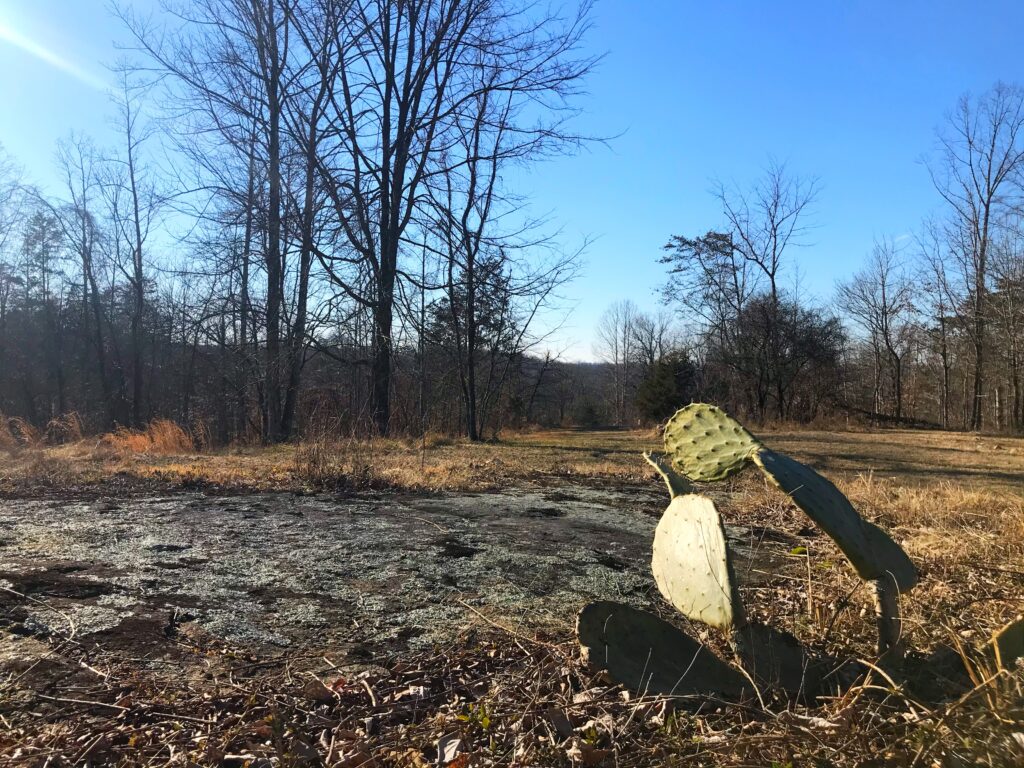
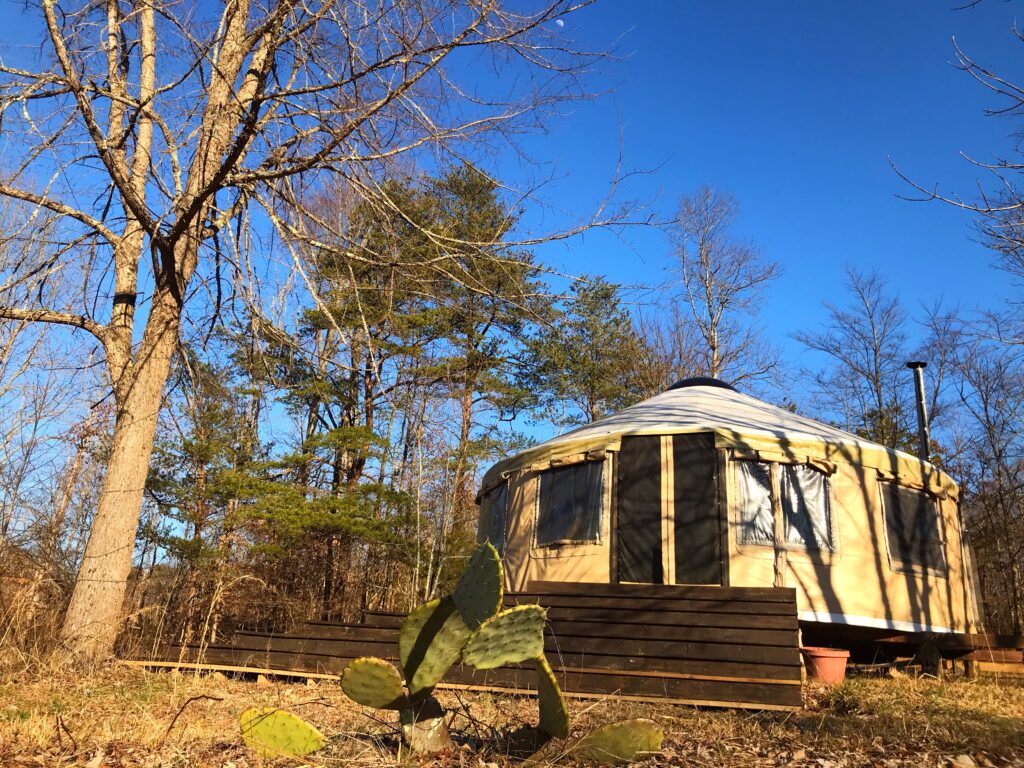
The “Cactus Rock” at Deer Thicket Sanctuary

Have you ever walked alone through the woods naked before? I have. It feels like peace. It feels natural. You can feel yourself embracing the animal that you are, your true essence. You feel every stick under your feet, every bug that lands on you, every blade of grass, and every branch that brushes against your skin. There is no barrier between you and nature. It is liberating and wild. I’ve only experienced such freedom at Deer Thicket Sanctuary before, last summer. And there was one thing that made the experience so much more pure and meditative: The “cactus rock” as I’ve named it. The “cactus rock” is magical, and the main reason I visit my family friend’s 83 acres of land in Kernersville, NC.

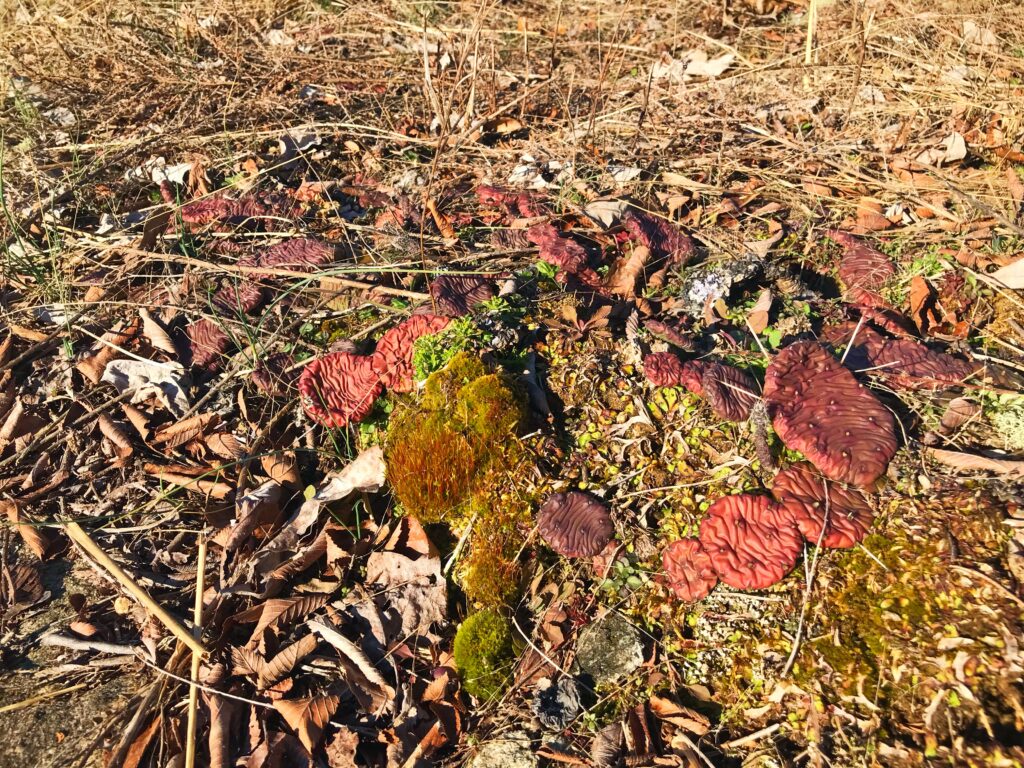
I arrive at Deer Thicket Sanctuary with a motive in mind. I’m going to get to that “cactus rock” and relive my previous experience, but clothed. As I drive on the gravel road towards the woods, I see my family friend’s house and their two dogs who are running towards me to greet me. The trees around me are all naked without their leaves, the sky a bright blue backdrop. As I step out of my car I feel a cool breeze across my face causing me to grab my hat and bundle up some more. I walk towards the yurt located in a field on their land. I go towards what’s familiar, although there is so much more land to explore. I stroll through the thin patch of woods, crunching the dry leaves beneath my feet. It is extremely still and quiet; I feel as if I’m being watched and I probably am, considering I am surrounded by so much life. I get to the field and I finally see “the cactus rock”. This flat rock is embedded in the ground in the middle of the field, surrounded by cacti. The cacti during the spring and summer look much different from now; most of the cacti are shriveled and have turned a purple-red color, so it is much easier to step over the shrunken cacti barrier. When I step on the rock, I see Pilot Mountain from my stoop. I lay down on the rock and feel the familiar feeling of the magical cactus rock giving me a high sensation- a meditative, calm, centered experience that I’ve only ever felt here. I feel one with the earth, connected to everything around me. I almost feel light-headed, but yet so strong and powerful. I feel like my spirit is grounded to the very core of the earth, connected to the universe and higher power. This is my church. I pull out my book and start reading Mary Oliver’s poetry, as it feels appropriate for the occasion.

Below are images of the “cactus rock”, the shriveled cacti, and a view of the yurt from the rock.

Below is a map showing the coordinates of the “cactus rock”.

I start to hear the sound of a woodpecker ferociously pecking a nearby tree, so I look up from the compelling poetry in my hands. It is still so quiet around me that the sound is almost deafening. I look at the woodpecker and laugh at him and his natural, but awkward movements. I start to look at the trees directly above me and I can see the moon through the branches. I love this place and I can’t wait to return and explore the places I’ve never been.

The Season Of Spring At Bog Garden

On March 10, it was sunny and a beautiful day to walk with your friends or family, but what’s even more beautiful is having a good time, discover more species and plants that bloom out toward the sun, and Spring season is here. As I walk on the pathway it felt so good to walk again not like the last time when it was cold and I felt really sick mainly my headache worse, but hey from the past, and good to start my first blog. As I mention walking through the pathway, there is a different specific area of the pathway or trail whatever you call it like the pathways are used to allow the visitors access and help protect plants the selection from stepping. The reason that because plants are sensitive and delicate. But enough about pathway which I’ll talk about it at another time. Nevertheless, Spring season is here already which I love and flowers started to bloom out beautiful, colorful, and good smell too, the species of animals started to come out as well fewer. As I kept walking looking around anything that surprised or interest me to see plants or animals, but in my mind when I think of the word “Spring” means is a time of renascence, revival, and enlightenment. The spring season is one of the majority wonderful seasons in humankind. This time of year, it’s a great opportunity to enjoy nature’s beauty and experience its rich diversity. As I walk I can hear the mini waterfall sounds like it went swoosh-plunk and hiss plop even with a force that moves fast at the stream. As I sat down on the branch I can hear a bird sound like a cheep note on a tree, so I went close, slowly, and quietly I started to take notes on my journal to make an observation. Technically it was a house sparrow bird, to describe its small, plain buffy-brown overall with dreary gray-brown underparts and the stripes on the back bird is buff, black, and brown which the gender is a female yeahhhhh lucky me. It was a beautiful sound and adorable cute bird. But I want to know more about the activities and significance in the spring season at Bog Garden back in the day and actually, in my research source, it said: ” The spring season also brings heavy rains that cause erosion of the paths, creeks, and can damage some of the more tender spring ephemeral plants of the Garden collections. The paths can also suffer significant impact from groups and some of the steeper and muddier paths will occasionally need to be closed to tour traffic.” Very interesting and that makes sense for safety, but also another important to check safety plants environment like it said “Early spring is also the time to check the canopy for dead branches hanging over areas frequented by people and they should be removed if considered a hazard.  If a tree is dead and needs to be removed, leave the lower 12 feet standing as a snag if it is not dangerous. Trim back shrub and tree limbs that grow out into the path.  This will need to check each season. Spray or dig A. italicum. There are also repairs to paths, path edges, bridges, and other garden infrastructure.” I understand that plants need to be careful and treated when it comes to seasonal Spring where it blooms, extra care, making sure smells good, and so on. Spring is the best and beautiful season even gardens are nurtured by a strong community.

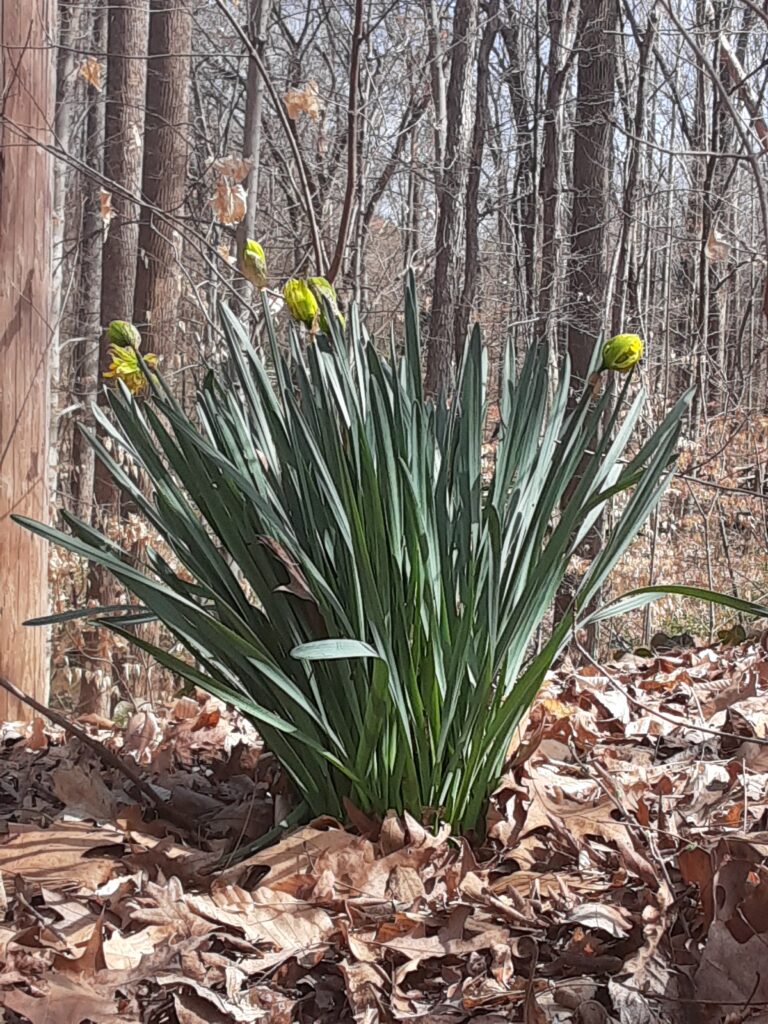
A Unknown Flower That is about to Bloom Beautiful

Winter in the Woods

During the dead of winter, all the leaves that once clung to the tree now cover the ground. The fallen leaves create a slippery layer. Sometimes if the temperature is below freezing, the leaves become frozen. You’ll hear crunch, crunch, crunch with each step. Bending down to investigate what you had just broken, you will see small white ice crystals that have formed underneath. However, in the areas with long direct sunlight, the ice is melted into a shallow puddle. Be careful so you don’t slip. It takes about 6 to 12 months for the leaves to decompose and return to the soil. This is why if you dig into the dirt, you may still find leaves in the process of decaying. Microorganisms that eat away at the leaves to break them down, require a humid environment which isn’t available during the winter. Most everything feels like it’s on pause. The woods are quiet and still. Mammals are hibernating, a lot of insects are dead but crows are everywhere. Giant black birds speaking loudly to each other, walking and flying around all over the place. Crows are one of the most intelligent birds on Earth. Don’t get on their bad side because they can remember your face. They might even gossip about you to each other. They thrive in the cities because they’re not picky about what they eat which explains why they’re thriving on the Guilford College campus. 

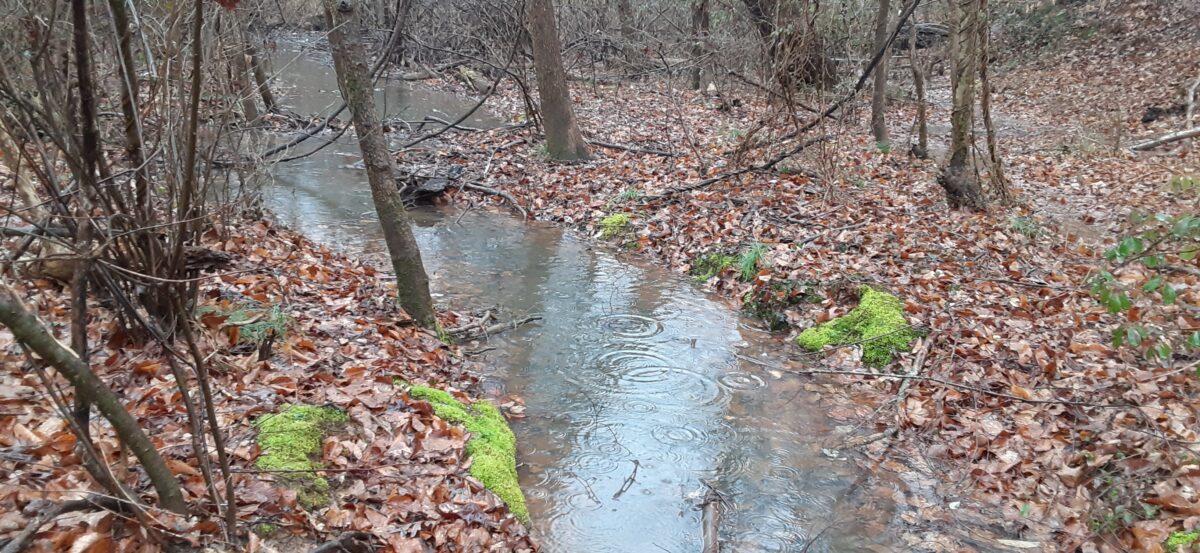
  If it does snow, like it did briefly a couple times this year, the snow will melt on the pavement but it sticks around under the shade of the trees for a little while longer. The snow lingers and is enjoyed by the few people who dare enter the woods on a cold winter day. The temperature drops dramatically after the sunsets which is as early as 5 o’clock. Overnight, the small pools of water freeze if it gets cold enough. Without getting below freezing temperatures very often this year, the ground becomes muddy from the cold rain. The woods are very swampy in general but especially during the wet seasons. Thin rivulets become wide streams that are difficult to cross. The walking paths become muddy streams as well, so don’t forget your boots.

   The woods (Greensboro) is located in the Cape Fear watershed. The streams in the woods flow into Horsepen Creek. The Horsepen Creek has been identified as an impaired stream by the State of North Carolina. An impaired stream is one that has been identified as having water quality concerns and can no longer support their intended uses. Developments such as roads, parking lots and buildings which have been built along the streams that contaminate the water supply. The small lake that sits along the edge of the woods made by damming a small stream in the 1950’s and was intended for recreational use. The water quality in the lake is lower than the streams following it. This could be due to runoff from the athletic fields and Friendly Avenue. The school does not allow people to use the lake for recreational purposes these days but is still visited by many, but not as many in the winter. Humans are hibernating just like the rest of the woods.

Trees along the French Broad River Greenway

The predominant trees include: Black Cherry, Sycamore, River Birch, and Box Elder.

The Black Cherry tree is a deciduous tree that grows all along the Eastern side of the North American continent. It can grow up to 25 to 110 feet tall. It is aromatic and has white drooping flowers. It has dark red fruit. Its foliage and bark when crushed have a distinctive cherry-like odor and bitter taste. Its wood is used for furniture, paneling, professional and scientific instruments, handles, and toys. The bark can be used to make wild cherry syrup that acts as a cough medicine. Jelly and wine can be made from the fruit. The fruit may be edible but the rest of the plant can be toxic because of the cyanide-forming toxic compounds, like amygdalin, found in this tree. The tree was also one of the first “New World” trees brought back to England as early as 1629. It is now highly invasive there and in northern South America.

The American sycamore tree is a wide-canopied, deciduous tree. It can grow up to 75-100 feet tall and has a massive trunk. Its canopy is made up of an open crown of huge, crooked branches and is classified as a shade tree. Larger and older sycamores lose some of the bark at their tops to reveal the smooth, whitish inner bark. The wood can be used for furniture parts, millwork, flooring, and specialty products.

The River Birch tree grows along rivers. It is also used for landscapes and can be planted almost anywhere in the US. It can withstand wetness and some draught and grows quickly. It has unique curling bark and spreading limbs. It works well to lessen erosion along stream banks. Songbirds enjoy the seeds. Deer eat the foliage. The wood was previously used for ox yokes, wooden shoes, or other farm products. They were not logged much because the wood is knotty and spindly.

The Box Elder is native to all states in the US. It is in the maple family but has compound leaves like an elderberry. The tree is often described as ugly and weedy. The tree is very adaptable and grows easily. Its wood is soft and has no commercial value. They stabilize stream banks and shelter wildlife, but in urban areas they are thought of as weeds. The trees germinate very easily and will spread, but they also have brittle and weak wood that makes them easily broken in wind and ice storms. They can grow in most soils but prefer it to be either dry or wet.

The greenway has many Box Elders and River Birches. There are much fewer Sycamores and Black Cherries. The Box Elders are very scraggly trees and have lots of little branches going in all sorts of directions. They are not beautiful trees. However, they do their job along the river banks to keep the erosion down. Reading about each of these trees, the interesting things that stand out are the descriptions of the uses for these trees in the past. They all have some element that was used or at least tried to use but humans. I think it is apparent in the amount of each tree there is along the greenway. The Box Elder is the most plentiful and most are big and beat up which correlates to it being very unfavorable to use by humans. They have been left alone more to hold up the bank, but also because there is not much reason to cut them down other than their unfavorable appearance. Nevertheless, appearance is often important to humans, so they have probably also been cut down previously simply because a human wanted a better view.

Source Links

https://www.wildflower.org/plants/result.php?id_plant=prse2

https://www.nashvilletreefoundation.org/blog/2019/11/5/tree-profile-box-elder-acer-negundo

https://www.wildflower.org/plants/result.php?id_plant=ploc

https://www.arborday.org/trees/treeguide/treedetail.cfm?itemID=792

https://www.gardeningknowhow.com/ornamental/trees/maple/boxelder-maple-trees.htm

css.php