Buenas noches,
Hope you’re doing well!
Just imagine: flower-pot tandoor, homemade naan, first person narrative, interactive table, beautiful spiraling maps.
This is a sliver of the creative ideas the Tongue group has fabricated. Since bonding over food we’re feeling much more comfortable around each other and more open to brainstorming ideas.
Zach is still developing his idea to make a cheap tandoor oven. Apparently the cheapest way is about $200, but that’s still too much for our budget. We’ve discussed getting a club, perhaps the Asian Cultures or International Club, to sponsor the project and then donate it to the college. I’ve personally thought of cooperating with the Bonner Food Market or the Farm in some way..perhaps they could incorporate a tandoor into their efforts to diminish hunger. We want our final presentation to coincide with a meal that we prepare ourselves, with fabulously timed tea pouring skills.
Thus far, we’re all slightly frustrated. We’ve done research and brainstormed ideas, but feel as if we don’t know the destination to hone in on. We’ve done loads of research, but feel like it’s not making much progress towards our goal. Even after the sessions with Rachel I’m still slightly overwhelmed by the myriad of sources, but plan to meet with her to narrow them down. Additionally Eric’s and Zhihong’s remarks about unapologetically honing in on a narrow topic, as long as you discuss that there are other factors and topics left untouched, are valuable.
I feel like the whole group is stuck in a limbo where the deadline simultaneously feels far away but the work feels urgent.
Some productive work we did was on story maps. We discussed multiple story map ideas, like following the experiences of a traveler leading to a culminating meal, each of us embodying a person along the way, or focusing on a virtual table. We were fond of the first idea, but decided that it would limit our ability to highlight histories and processes that the traveler themselves wouldn’t experience. Therefore we thought it would be really intriguing and unique take on the persona of “middle-men” in Kashgar. To keep to his research themes of spices and livestock, Chris would be a shepherd, butcher, merchant, or perhaps a cycle through all three. Zach would be a cook or street vendor to focus on beverages and cooking. To illuminate cooking equipment, utensils, and clay Billie would be a potter or metalworker. We even found a real 7 year old potter from the region named Anwar Ali!!! And finally to manifest how eating relates to culture and customs I’d be a homeowner, or the one hosting a guest. As for the table idea, Billie suggested that we make the table holding our meal the focal point of our map, and zoom out from each dish to our respective research.
Here’s our expert sketches and ideas:
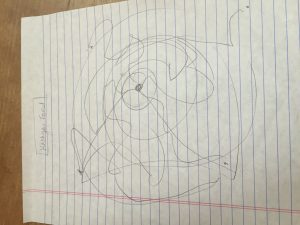
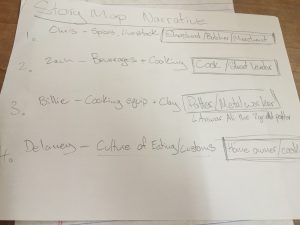
Our narrative ideas are currently limited by our lack of knowledge of the StoryMap site. We’re not sure how much information we can place at one point, or how the different points link together. Luckily we’re going to have a class session on it soon.
The final update is that we’re planning to meet weekly at 9:00 on Mondays, to keep a consistent schedule.
Hopefully that was coherent enough to communicate our progress! Thank you for reading!
Regards,
-Delaney
Monthly Archives: September 2016
Technicalities…
The tides are high here on the Digital Silk Road. Right now we are in a bit of a adjustment period. Think about it: Digital Humanities can seem a little like chaining a bunch of humanities students to the computer. We’re humanities students! We like books, not blogging! I keep thinking back to a phrase that a teacher of mine once said: when the tides are high and the winds are strong, lower your sail.
This week has been hard. The work load has gotten the better of us. My whole team has been working hard, but so far there hasn’t been any great pay off. My fear is that we are getting lost in our research and forgetting to keep our scope narrow. Because we do not have a vision for our finished product, it is hard to find direction.
Here are things that I think we need to keep in mind as we move forward:
- We will be using a contemporary map! We can attach photographs of old maps into our Storymap, but we cannot trace our route on it.
- We have to be explicit in what we are and are not looking at. It is only ethical to do so.
What I have been stressing to the team this week is to be mindful of how our information is being presented. What story we tell must fit the framework of Storymap JS. Therefore, we do not have to think about time as much as we do about space. Check out some examples of Storymaps here.
– – – – – – – – – – – – – – – – – – – – – – – – – – – – – – – – – – – – – – –
Speaking of presentation, the other Silkworms and I met with Tierney to discuss how to be administrators of the blog. I won’t go into the nitty-gritty details, but we did stumble upon the subject of web design. I realized how much I care about making this site look good. I think in all our efforts to get this course up and going we have made one over-site: making a webpage that people actually see is not EASY! And if anyone actually does see it, it better be visually enticing–otherwise they will exit right out of the window. To address these problems, we need to do a few things:
- Start placing “Tags” on our posts. I suggest that each team comes up with a series of tags that they consistently use in their blog posts. This will be key in getting viewers!
- Because we are blogging so frequently, we should start to make our posts pretty. We should stress that everyone incorporates at least one image in each post, and should use at least one hyperlink. Keep it interactive!
Both of these things should be started sooner rather than later. It will make going “live” smoother.
The image above was taken by the Japanese photographer, Hiroshi Sugimoto. It is a silver gelatin print taken in 1992 of the Yellow Sea, Cheju. I first stumbled upon this artist, actually, while I was staying at a friends house. They had an original hanging right in guest bedroom! I did some research and quickly realized that Sugimoto is a BIG deal. Check out the rest of his Seascapes series here!
Post-meeting reflection 9/20
Last night our group met, because we now meet every Monday night (this week at 7:00, every week in the future at 9:00). We discussed what we had each done up to this point, which, to be clear, has been minimal for all of us. Zach is stoked about Tandoor ovens and Youtube videos about making them as well as videos on street food and other meals in Kashgar. The rest of our research seems to be rather hard to progress with. Delaney and I were talking about how there seemed to be some stuff to read, but that nothing felt valuable or felt like progress. There are very few books about the history of Kashgar, let alone food or culinary practices in Kashgar; the research on Kashgar I have done in various databases is also fairly limited and feels like context rather than the content we hope to have in our project. I have had slightly better luck zooming out to Xinjiang and hoping to find specifics about Kashgar within. My next step is going to be expanding my search to google and not just databases. I am hoping to sift through websites and any other results that might pop up form google searches either today or tomorrow (9/21). Ideally I would like to be spending at least 30 minutes to an hour every day on research for the Tongue team and I am hoping to attempt to accomplish that minimum this week as a trial run and see how successful I am. As a reminder to myself and a statement that might help keep me accountable for fulfilling this: I need to create a more thorough and upgraded timeline for my group as “timekeeper”.
The largest part of our meeting centered on how we were going to make a narrative out of our separate parts of the whole Tongue Team project. This led us to the question of how we wanted our portion of the map to look like and how it will travel from point to point. I was envisioning a picture of our meal as our main point and then have the ability to click on each aspect of the table in order to bring you to the background of each component of the meal. I don’t know, technologically, if that is possible, so we also discussed how the traditions of the order of what got served or eaten first might help us with how the digital map travels from point to point. We discussed a lot of ways in which we could turn our project and all its facets into a map for the final project. It was really fun to think of that creative aspect of the project and to look ahead at what it might look like when it’s all said and done.
Monday Meeting Debrief: How to Create a Linear Narrative with Many Different Elements
Last night, I met with my group in the library to set up a basic plan of attack for the next few weeks. We talked about how setting up specific data finding/creation deadlines to make our group progress schedule a bit more specific. As per Eric’s advice, I recommended adding deadlines for having all of the images, all videos, all text completed, etc. as we anticipated that data entry will take longer to finish than groups might think at this point.
In our administrator meeting yesterday morning, we discussed that each team will only be allowed to use one single StoryMap to present the work of their entire team, rather than creating multiple maps for different sections of the project. I think this will be particularly daunting for my team since we don’t necessarily have one singular storyline, but one meal that traces out in multiple lines in different directions since they are tracing different ingredients and elements of the meal backwards through time. We made a lot of progress in imagining how our StoryMap will actually end up by drawing out different formations while brainstorming. The best idea that we came up with was to create a center point with the image of the entire meal and take each element, in order of their consumption throughout a typical meal period (starting with drink, first course, second course, etc) and then zooming out to the beginning of the history of that element and tracing it back to the table and overall meal. By tracing inward rather than outward, each element will end at the center and refocus on the larger picture of the entire meal. We will then proceed to trace the next element from the outer-most point inwards and so on. This will make the phases of the project seem almost like flashbacks that lead the reader to the final meal.
We talked about how we will maintain a narrative within this format. We had originally envisioned telling the story from the first person perspective, allowing one person to witness where the ingredient came from and they got it to the table. We also brainstormed telling the narrative in the first person as the ingredient itself. We came upon a final solution of telling the story in the second person perspective, allowing the audience to be the center of the narrative and having them be the person bring the ingredients to the table. This will create a narrative that seems almost like a “choose your own adventure” novel, but structured to be a directed story rather than a number of audience choices.
I was worried that the limited format of StoryMap would limit our narrative abilities, but I think that we have come to a very good agreement and new arrangement for our information. At this point, my team is feeling anxious to learn about the StoryMap tool and is eagerly counting down to our next Tech Lab.
The Process: 1
Process posts will, believe it or not, reflect on the process our group is through in researching our topic and completing this project. After getting together today to research and brainstorm, I’m feeling much more confident about our current path. We’ve highlighted personal responsibilities, our research outlines and have even managed to schedule a weekly meeting time (incredible, given our various schedules).
Though we primarily researched on our own during the hour, we also bounced ideas off one another regarding how we’ll be presenting the final product as a narrative. Unfortunately, as of right now, we don’t have much knowledge of the story map program we’ll be using for the final piece and what its capabilities are. Our goal however, is to write our research out as a story, following specific people’s lives in Kashgar. We’re thinking about placing the audience around a dinner table and zooming out to different aspects of the meal from there. We even drew up a fantastic diagram of what this could look like which I tried to attach, but upon previewing it, could not see it clearly.
Given these posts are meant to include some reflection on research, I’ll be attempting to throw in a piece of information or quote I found interesting with each post. Here’s an appetizing description of a popular Kashgar snack according to the website Chinatouronline.com.
Lungs and Intestines. “A traditional snack and Uyghur favorite, Lung and Intestine poured with Flour and Rice is made of the lungs and intestines of sheep. The lung poured with flour is soft and the intestines are tasty, causing tourists at home and abroad to praise its special flavor.”
Anna's Monday Meeting
This morning I met with the other Silk Worms, Eric, Zhihong, and Tierney to chat about administrative functions of our website and how our role in creating the technology-based aspects of the larger project will evolve. After this meeting, I have a much better understanding of what my role is within the larger project.
I feel that a lot of the actual administrative work on the current website that involves organizing pages, categorizing blog posts, etc. is pretty straightforward. I don’t think there will be any struggle on my part keeping up with those functions since I’ve done similar jobs on more simplistic websites before. I think that a good bit of the website design (on a very basic level) comes easily to people who have worked with computers in the past—even casually to browse the internet—so I don’t worry about our students being able to do things like create pages and blog posts. I think my biggest worry about the website management basics for both myself and other members of the class will be making sure that citations are done correctly. Our students are proficient in creating citations in a research capacity, but I expect complications from the new necessity to cite photos, videos, and other multimedia elements.
Other conversation that occurred during this meeting explained about how our larger map will incorporate elements of all of the team projects, in a color-coded diagram on top of a larger map. We will be creating this homepage map with Google MyMap, which Tierney showed us. From the basic introduction, I think this seems like a really useful tool and I could see myself using it to create tools for other programs, possibly for Guilford’s incoming student orientation or even surprise scavenger hunts for friends. Google MyMap is one of the tools we are learning that I think will become extremely helpful as a practical skill. I like that we are using this alternate tool rather than StoryMap to create the larger homepage map. I think this tool adds the flexibility that we need to create a non-chronological, non-linear display of four different projects simultaneously.
I think I understand the importance of our role much better now. This meeting clarified that we are not just doing busy work and data entry—transferring what our students create into map points in a different program—but synthesizing what our groups do into a summary and transferring that information into a cohesive, four-project map.
A New Journey for A New Heart
Hello everyone. I haven’t really blogged before, so I’m not quite sure how to begin, but I’ll give it a shot. I’m a member of the Heart Team, although, like Emily, I was previously a member of the Earth Team. My team transfer initially left me a bit out of the loop. The Heart Team already had a general idea of their focus when I joined, but my new group members and our Silkworm Elena were kind enough to get me up to speed. We eventually decided, based on the collective interests of all Heart teammates, to chart a dual course combining elements of music and dance with religion and ritual. Our newly-established focus led us to examine the cultures of the steppe, where we discovered Mongolian horse culture and the horsehead fiddle. Our topic is temporally broad at the moment, stretching as far into the past as the invention of the iconic instrument and as close to the present as the Mongolian metal scene, but I’m confident that we can create something great out of the wealth of information we stand to uncover.
I serve as the facilitator for the Heart Team. I took on the role when group members noticed that even in my first meeting with the team, I was listening to everyone and offering solutions to potential conflicts in an effort to help guide the brainstorming process. My role also involves keeping group members up to date on the research process and organizing meetings and discussions as they become necessary throughout the process. I haven’t had to perform these duties just yet, but I’m prepared to help keep things on track whenever the need arises. In terms of research, my focus is primarily on the role of music in religious ritual. I also hope to look into how music might be involved in medical practices, if I can find resources on the subject. I’m planning to focus on steppe practices of Shamanism first, and branch out if I can’t find enough information on that topic, or if I come across anything else that I find particularly interesting.
I’ve never conducted a project like this before. From the looks of it, neither have most people in this (completely new) class. I have some limited experience with programming within the relatively specialized setting of a physics laboratory (and maybe a little dabbling with Python), but I don’t consider myself very technologically proficient when it comes to creating digital content. Most of my code has been written for machines (or bewildered humans who aren’t quite sure why hypothetical rockets are hitting the center of Andromeda at the speed of light), so I’ll have to learn a new design mentality alongside any new coding skills I acquire. That said, I have used programming languages before so I hope the thought process isn’t too foreign to me should I need to pick up coding again. Web design on the other hand is an entirely new experience for me, and while it feels relatively intuitive at this early stage, I’m sure the project will find ways to challenge me that I haven’t even begun to think of just yet.
It might also be prudent to mention that I don’t have much of a background in history or religious studies. Although I greatly enjoyed the one religious studies class I’ve taken here at Guilford (Eric’s Tibetan and Himalyan religions comes highly recommended, just be prepared for a challenge), as a lab science double major (Biology and Chemistry), I haven’t had much space in my schedule to take any others. That said, religion and spirituality have always interested me. I don’t consider myself religious or particularly spiritual (I don’t have any adamant convictions one way or the other), but I enjoy learning about and considering all sorts of spiritual and philosophical traditions. I bring this up because I realize that in this endeavor, enthusiasm may be no substitute for genuine depth of knowledge and experience. I expect to learn a whole host of new terms, ideas, modes of thought, customs, rituals, worldviews, and much more. I also expect to have to ask for help somewhere along the way. There will likely come a point where I’m researching a topic that requires insights that others may possess. In this case, I plan to bring up the issue with my teammates and see if our combined capabilities can’t take care of it.
In a similar vein, I don’t have much musical experience. Long ago in ages gone past, my teenage self purchased a guitar to practice with for the summer and more or less forgot about it around a month later. Aside from that non-expertise, I don’t really have any musical background to speak of. Nevertheless, I’m excited to look into musical traditions in the hope that I might learn more as I progress. If our musical research becomes too technical for my limited expertise, I’ll focus more on the ritual side of things and leave the more advanced details to those with the skills to handle them. I’m also looking forward to listening to many different musical pieces as the project progresses, and potentially broadening my taste in music as well.
As I’ve already repeated more than enough times, I haven’t really done anything like this before. I’ve tended to do well with writing-focused research projects in the past, so I’m fairly confident as far as the research side of things is concerned. I do sometimes have issues with time management and sometimes find myself submitting assignments just past the deadline (look at the time this post was created), but I’m aware that I’ll have keep such tendencies in check for the benefit of the group. That said, I also do my best work when I’m given ample time to produce it. As a result, I’ll have to keep constant track of deadlines and make sure to set aside enough time for each stage of the project if I want to succeed. Though it will likely test many of my current skills and a few I haven’t learned yet, I’m looking forward to working with the Heart Team on this exciting endeavor.
First Blog Post: Team Earth and Plants in the Oasis Cities
I was initially placed in the Heart group, which was a sound placement considering that my main passion is music and art in general. I would have enjoyed studying musical instruments on the silk roads, but decided otherwise. The study of plants and their relationships with human society (mainly agriculture and religion) fascinates me deeply. I think that plants are beautiful and incredibly complex. Plants are, on the surface, quite alien to us, yet they’ve become chemically intertwined with human physiology. In order to pursue this interest in an academic setting for the first time, I switched to Team Earth. We initially brainstormed ideas of agriculture, irrigation, oasis cities, and the cultural significance of different herbs and crops. After some deliberation, we focused in on the Taklamakan Desert. Oasis cities were a key aspect of the trade routes that ran along the northern and southern borders of the desert; they allowed merchants to only traverse the desert in the small increments between towns. Those cities had to develop technology to control their environment in order to grow food and maintain the agrarian lifestyle. Of course, only certain crops were able to grow in the harsh environment that accompanies even the fringes of a desert. We plan on researching the diffusion of technological innovations such as irrigation systems and growing methods, the specific crops that were used, and perhaps the spread of different seeds or plants along the silk roads.
Our group has not yet decided on a specific place or time yet. We have the region and subject down, but there are so many options within each. Eric mentioned Samarkand, and Kashgar is a possibility as well. I suppose the time period will be limited by the amount of information we can find. Ideally, we would research different developments over a longer time period, but it may be too difficult. I think that narrowing our focus will be really hard, and will require a good deal of broad, preliminary research.
My individual focus will be on the specific plants used by humans in oasis cities. Whether a plant’s native, where it came from, its nutritional components, it’s prevalence in agriculture, etc. Beyond that, we don’t quite have assigned technical roles, it’s difficult to decide that this early in the project. I like to write, I like to research when I enjoy the subject. I’m pretty good with technology.
That ties into my main anxiety in this project, which really just boils down to time passing us by. It’s easy for me to say now that we can start narrowing things down once we really start researching, but weeks can fly by so easily. The only answer to that fear is to be proactive. I’m working on it. Within discerning our subject of research, my fear is a lack of information about agriculture and of historical documentation in this region. Solving my first problem will solve this one, because once I dive into the sources I found I will know where the information is. I have high expectations for this compilation of knowledge that we are about to create, I’m excited to see where it takes us. It is also exciting that on the trip to China we will travel along the Taklamakan desert and I will finally see what was once only a distant reality during months of research. The sheer amount of information that I will have to dig through this semester overwhelms me, and currently I’m not sure where to start, but I can’t wait to learn it all.
I’d say my work to date is mediocre. I’ve done enough to get by so far, but I haven’t yet thrown myself into the work. I hope that I can deeply dedicate myself to this project whilst battling through my other classes. I found a lot of sources for our project proposal, but I haven’t had time to delve into them yet. I think our group will work well together, we all seem to be on the same page and we have all contributed what we’ve needed to.
Pho and Focus
Greetings readers,
I hope you’re well!
Tonight has been one of fulfillment, of both stomachs and aspirations. Over pho and other East Asian dishes in local Greensboro joint, the Tongue group bonded and had a chance to converse about life without pressure of impending assignments.
At the outset of this project, I was honestly dubious about the results, and would never have imagined it to have gone as well as it has. Being objectively categorized into groups by interests sounded like a common-sense approach to delineate topics, but when I was categorized into the Tongue group I wasn’t sure that I meshed incredibly well with the other members. Instead of being a random amalgamation of oral-related interests (languages, food, social stratification and roles, etc) it seemed that it was a group of three vehemently excited by cuisine and one only mildly. Within this broad interest, we had group members interested in the rise and falls of empires, the role of women along the Silk Road, and linguistic diffusion. I wasn’t quite sure how we could come to a proposal all members were satisfied with.
Therefore our group was initially very malleable: all our fixations were orbiting around “tongue” aspects, but no one could pin down a topic that equally incorporated everyone. After reviewing a timeline of nomads in class and being urged to looking into spices by a professor, we loosely decided upon researching spices and the Xiongnu people. However we soon realized that there were very little sources about either of these (spices had substantially more, but not from the timeline we had honed in on), and it seemed like we were just spinning our proverbial wheels. To start over, two members met with Eric and crafted the idea of focusing on the Kashgar region and following a meal.
Within following a meal from the Kashgar region, our team split into four focuses to make a more adequate attempt at gleaning a speck of knowledge on the topic. Christopher is focused mainly on foodstuffs (yoghurt, meat, vegetables), Zachary on beverages (grain, yoghurt, milk wine), Billie on preparation and consumption (utensils, ovens, dishware), and I of the cultural role (etiquette, types of meal settings, cultural diffusion). More specifically, I’m focusing on the customs and traditions behind dining, serving, and consuming.
I’ll admit that I was a mite disappointed when we shifted from a language-focused topic to one of cuisine, but I soon realized it was a blessing in disguise. I love linguistics, but dealing with translations and mapping of tongues that I’m not even remotely familiar with within the confines of this course would have been impossible. Additionally, it’s much more interesting to foray into an entirely new topic than adding to one with a sustained bank of knowledge. I’m actually very intrigued by the cultural concepts behind food, and how food can translate culture in the stead of a shared language. I’ve always found “exotic” food interesting to the palate and the mind, but the way it originated never sparked in my mind as an area of research. While I’m excited to journey into a new area, I’m a little frightened by my lack of expertise. Everyone else in my group can name food documentaries, dishes, and restaurants off the top of their heads, and I sit there enthralled but reeling. I just hope in my unfamiliarity I don’t drag them behind. We had hoped to dine at Apple China tonight but consumed pho instead, I engulfing myself in a cloud of culinary cultural awareness I didn’t know existed outside of cooking shows.
Anxiety-wise, I’m nervous about research and reception. I’m grateful that my topic is probably the farthest removed from the food itself, but am still unsure of how to find sources. I’ve done many collegiate research papers and projects before and can list numerous sources by rote, but absolutely nothing about food. I’m hoping that I can find guidance in the librarians, the professors, and my group members, but I want to be able to stand as an independent entity, not burdening them. Obviously in the time since writing emerged in Asia there must be enough combined sources, but I’m afraid I won’t access them. As for reception, I’m not quite sure of the effect this project will have. Eric urged us to avoid being daunted by this task, because it will only be “a drop in many oceans”, if that, but I still want our project to be original and significant. Through synthesis of established sources I’m not sure how many radical new ideas will emerge.
At the outset I believed that our group was a thrown together group of individuals, but ended up discovering that Zach, Billie, and Chris had all closely bonded freshman year. This naturally made me feel like an outlier, and wonder how the dynamic would progress. In the beginning I think our issue is that we were too polite with each other: no one dared to say no, or shoot down an idea. A contained version of this is fine when brainstorming, but we ended up in a place where we had a myriad of ideas and couldn’t sacrifice any of them. I think we, or at least I, also felt slightly confused working together because none of us were sure what the actual specific outcome of the class was supposed to be. We had meetings to brainstorm and seemingly got nowhere because we couldn’t decide what to hone in on. However after nailing down the topic of Kashgar cuisine we seem to be doing well. Continuing research on dishes to solidify our plan, but slightly coasting, working towards our next deadline. We’ve spent our time tossing around the ideas of tofu raps and food documentaries and interactive website karaoke. I think once we recognized each other as people other than project partners productivity flourished.
Thus far, I would honestly say that my efforts have been more minimal than they should be, at least in comparison to other members in my group. They’re regularly watching food documentaries and seeking additional context, and I feel like I never have much to add. I’ve completed all the required assignments and pulled my weight in suggested research, but haven’t done much additional research. It’s not for lack of interest; I have a dozen documentaries in my queue. Nor for lack of will. More lack of time in a busy schedule. Between four classes, three clubs, three jobs, and applications, I don’t have much free time to explore my own fancies. I think I’m on-par with the expectations of the course, but not actively engaging enough to satisfy my own curiosities or aspirations.
Overall, I’m very excited for the course and trust in team ingenuity. Thank you for reading.
Regards,
-Delaney
Be Still My Beating Heart, An Initial Blogpost
When we first began the discernment process I was admittedly a little frustrated. As a seasoned (possibly even a slightly jaded) senior at Guilford, I am at the point in my academic career where I have figured out the exact formula for group projects. The catch is that this silk road endeavor simply doesn’t fit into my meticulously sculpted mold due to its experimental, multi-faceted shape. I think the most difficult thing for our group (once we all fell into our respective places regarding broad topical interests) was the sheer breadth of possibilities for our research. Our lack of prior knowledge on the silk road and its endless intricacies made us feel a little bit helpless, like we were flailing around in a stormy sea of JSTOR links, and reminded me of something that one of my favorite theatre professors, Marc Williams, always says about directing exercises: “Limitations are freeing.”
However, once we met outside of the classroom setting in a library alcove and began bouncing ideas off of each other’s bewildered brains, I became immediately inspired: while limitations can certainly be freeing in the sense that a thesis should be pointed in a specific direction and prompts can spark new stories in creative writing, we were actually able to choose our own limitations, to set our own parameters. This is such a cool opportunity because we are picking subjects that legitimately matter to us. We knew that we were interested in everything from music, shamanism, animals, and the steppe regions. Within just a few meetings we came up with the following goal statement: our goal is to determine how the movement, spread, and dispersion of musical traditions in the Mongolian Steppe are related to regional religious and ritual practices. If we do find that they are related, we plan to examine how growth and change in one area might have affected the evolution of the other. One instrument that may have been particularly impactful is the horsehead fiddle, traditionally played in Mongolia and often made at least in part from the animal it emulates. We aim to investigate how the use of the horsehead fiddle is connected to Mongolian horse culture, riding, and ritual. We also suspect that music, dance, and spiritually significant instruments play important roles in the shamanic traditions of the region. In light of this, we may also cover some shamanic practices that relate to our overarching focus on music in the Steppe. Overall, we hope to determine how musical and religious traditions intersect within Steppe culture, and how the exchange of ideas throughout the Silk Roads may have influenced them or helped them spread to other regions.
I am so lucky to have experienced the initial discomfort that I mentioned previously, because I think that it is expanding my previously narrow views of what roles students and teachers should and shouldn’t take in the classroom. We are claiming our own academic autonomies in ways that I don’t think any of us expected coming into the course, and it’s honestly awesome. Intuitive, self-motivated research is such an important skill, and I know that it will serve me far beyond this course. The technological aspects will also serve me farther on down the line, although I am currently feeling very comfortable with WordPress because I have used systems similar to it before. I am also learning about what it means to legitimately trust my peers with important project tasks: Jilly volunteered to upload the final version of the proposal for our team, and it was actually a relief to release my typical inclinations towards micromanagement. I think that this project is already helping me become a better (and more pleasant) team player.
My individual role is technically reporter, which means that I will be articulating our progress to the class. Serving as the vehicle for our syncretism will be good for me because I often approach my personal research in a fairly haphazard fashion: one thing will interest me, and then while I’m delving into sources on that thing I’ll find something else… and so on and so forth until my research becomes a black hole. It will be really nice to be forced to report in an articulate fashion exactly what we have been working on. In addition to reporting our findings, I also have a specialized area of research within the more broad parameters, due to my particular interest in shamanism. Rituals across the entire span of the Silk Road employed various types of music, and I will be researching the introduction of different musical movements and the impact that those changes had on the performative qualities of Shamanism. I am particularly interested in the implementation of horses and horse imagery in rituals, which our group has included in the proposal through the idea of the horse head fiddle.
This is a very busy semester for me, as I am conducting my senior thesis for my Theatre major this fall. While I am beyond excited about all the things that I am learning in this course (my research on the silk road and shamanism currently serves as a sort of break from the madness of the semester), I have not allotted nearly enough time to this project so far. I have only skimmed one of the books that I checked out from the library last week, and I still need to devote a good chunk of time to doing preliminary research online. I am proud of my team’s excitement and our ability to listen compassionately and intelligently to one another, but I am aware that I could be bringing more to our meetings. I plan on doing more research outside of group meetings so that I can focus more on cohesion and that syncretism that I was so excited about when we are all together.
Overall, I think that The Heart team is off to a smooth start, and that we will continue to thump regularly along for the rest of the project. I look forward to updating you all with our findings as the semester progresses.