All posts by davisdc

Kashi-ing Up to Kashgar: Tandyr to My Heart

Buenas Noches readers,
I hope your day’s been swell!
The Tongue Team is getting down to the nitty gritty topic we’ve all been waiting for……….FOOD!
Since the focus of our whole digitized project is cuisine in Kashgar, we thought it appropriate to present and serve a meal during our presentation, and to focus our Prezi points on a photograph of a meal we create. We’ve long been discussing the logistics of building a tandoor oven, and through fire permits, changing locations, and fluctuating prices, Billie and Zach finally got it built today! The original plan was to donate it to the Guilford Farm, but the oven would need to be under a structure to prevent rain decay, which would violate fire codes. Therefore Zach now has it stationed in his backyard.

fullsizerender-2
Inside View of Tandyr, Billie Dunn-McMartin, 2016.

(I’ve provided a very low-quality view of the inside. Video credits to Billie)
Saturday Zach and I, perhaps Chris and Billie, are venturing to Costco to purchase the ingredients for the meal. Here’s the very rough shopping list we formulated (that is by no means complete):
-Kabobs

  • Lamb or chicken
  • Cumin
  • Chili Flakes
  • Fennel Seeds

-Naan

  • Dry active yeast
  • Salt
  • Sugar
  • Flour
  • Sesame Seeds
  • Poppy Seeds

-Pilaf

  • Chicken
  • Jasmine Rice
  • Carrots
  • Onions
  • Garlic

-Tea

  • Black tea

I’ll be providing the wok for the pilaf, Zach the tandoor oven and the hand tools, and we’re all hunting for a porcelain teapot and dishware (or at least good replicas). Billie has searched Goodwill, but we’re continuing to search HomeGoods and thrift stores.
To append to Billie and Chris’s Honor’s project over the J-term trip, we’re filming every aspect of the process: building the tandoor, purchasing the ingredients, practicing the food preparation, cooking the meal, and serving it. We thought cuisine too three-dimensional a topic to simply be read about, and it certainly lends itself to being interactive. We’re going to incorporate it as a series of videos on our map and site page.
 Fortunately, tonight’s reading coincided with a main focal point in our project: the Uyghurs!
One of the first sources stated that “Uighur” is not a romanization of “Uyghur” (or vice versa) but a completely different ethnic group! I was immediately concerned, because I wasn’t sure that all of us delineated between the two in our findings due to the fact that we thought them identical. However I could find no articles supporting this statement, though I did find many stating that the people themselves prefer the “Uyghur” spelling because it is more in accordance with phonetics of their native language (“Uighur” violates vowel harmony). Other sources went in depth to the rise of Islam in Xinjiang, evidencing why Kashgar has such a religious focus. The Karakhanids established their capital in Kashgar, and sometime later Yusuf Khass Hajib wrote “Wisdom of Royal Glory”, which referenced the Quran and hadiths, providing stark evidence of Islam. Kashgar became a Muslim religious center but was eventually taken over by the Manchus, though Yakub Beg later established an independent khanate to return Muslims to power.
I realize that was a fairly brief update on the multi-faceted beast of this course, but I hope it suffices! Many more insights to come.
Have a wonderful night!
Regards,
-Delaney

Kashi-ing Up to Kashgar: Research and Respite

Ciao readers,
I hope you’re well!
There’s been much that’s occurred since I last blogged.
Last Tuesday, most of the course trekked to Chapel Hill to see esteemed Sufi musician Youssou N’Dour perform an amalgamation of religious and “pop” music. Although Eric and a fellow professor I was riding with seemed to be ecstatic over him, I honestly didn’t know what to expect. Would the music have more auditory similarity with African music than Arab? Would the music be restrained, or lively? Would it have an overt religious focus? I could’ve easily browsed his repertoire on Youtube, but I wanted to be surprised, letting the live concert be my first experience. As soon as the first musician approached centerstage, the auditorium was awash with color from the embroidered robes and caps, and booming with a cacophony of instruments. I recognized some of the drums spoken of during the little pre-concert presentation we attended, and mulled over the fact that to play ⅔ drums displayed one must be born into a genealogy of drummers. This theme of genealogy seemed an integral theme in the Sufi tradition, because apparently most of the songs Youssou sings are recitations of family histories. Sometimes people are even hired to memorize family trees and sing them at events! Another tradition, or perhaps just a one-time event, I found curious was the collection of money by the performers. One older gentleman with the surname Mbaye (who was N’Dour’s musical inspiration as a child) incited viewers to swarm the stage during his performance, offering bills which he swiftly pocketed. Later a younger performer made rounds with a basket. Overall, I found the concert incredibly engaging. Instead of a somber, dignified affair, it was lively and struck something in me solely with the sounds, as I couldn’t understand a single word.
To switch gears to the Tongue Team’s project, we’re currently in the process of compiling individual research. My focus on culture and customs has narrowed to hover around the practices surrounding lokantas and tea. Lokantas are Turkic cafes, mostly frequented by those of the Uyghur ethnicity, that serve snacks and conversation between community members. They are often divided into sections for men, women, and children. To simplify, they could be compared to Western cafes. I’ve found many recent sources documenting these establishments, however I ran into a complication with my historical research: “lokanta” was (and is in some places) also a general Turkish word for restaurants. This means that most of my search results in academic databases are in Turkish (without translation) and the results are broad, not honing in on the specific type of lokanta I’m seeking. I peddled around for awhile trying to avoid taking on the bear of translation, but most of my other lokanta sources were just blogs/first-hand accounts and not proven as scholarly, so I thought I still needed something to supplement them. This Monday I met with Rachel, the research librarian at Hege, to discuss my hindrances with this topic. She provided me with a myriad of options I hadn’t previously considered:
-Finding a Turkish speaker at Guilford through the Study Abroad office or the Learning Commons
-Contacting the Islamic or Turkic  Studies department at UNCG
-Getting sources from NPR cultural pieces
-Using other sources like anthropology databases
She assured me that I could use blog or more contemporary sources as long as I felt them legitimate.
We also got into a discussion about tea, from whence she recommended “A History of the World in 6 Glasses” by Tom Standage, which contains a whole portion on tea. I’ve requested for the library to order it and am excited to see what it holds!
Below I’ve attached an exterior example of a lokanta:
download
Thank you for reading! Bis dann!!!!
Regards,
-Delaney

(Kashi)-ing Up to Kashgar: Picture Perfect

你好,
I hope you’re doing well! (And am mildly proud of myself for finding a Chinese keyboard)
Last week, following her comment on my post, Tierney linked me the instructions to create a Gigapixel StoryMap. The online example was enthralling: focused on a famous Impressionist painting, each slide zoomed in with remarkable detail, even going so far as to comment on an individual brushstroke. Our group was very excited for the possibilities. We proposed that we could zoom in on each individual dish and ingredient in the meal, and then provide information on point from there. While this sounded great in theory, Tierney brought up an important point I hadn’t considered. In order to get such a high quality zoom on the map, we would need an incredibly high resolution photograph. This outed our idea of simply scanning a sketch of a meal we fabricated, taking a picture of a pre-existing meal, or photoshopping one together.  We also proposed going ahead and generating our points on the map and placing a background later and shifting points around, but Tierney informed us that the site doesn’t function in that manner. However Tierney stated that she may have misunderstood our project ambitions, and will continue searching for other sites and applications.
In Friday’s class, she introduced us to GIPHY and hipster ipsum, both valuable resources to spice and mock up our website while it’s in the developmental stage.
In addition to these new applications, Eric provided valuable clarification about the final product. We need an amount of points vastly smaller than we had anticipated, which makes it much easier to formulate a cohesive map.
Up until this class, and perhaps even after, I think everyone in our class was anxious about the expectations for the map. This being a new course, we had no model to base our own projects of off. But I know I personally was greatly relieved with hearing the dimensions and specifications for the project. It focuses on quality, not quantity.
In the spirit of the interwebs, here are two parting Gifs to represent my feelings about this project.
Before Friday:
http://lookhuman.com/
Now:
http://iheartcatgifs.tumblr.com/post/12968948480
Thanks for reading!
Regards,
-Delaney
 

(Kashi)-ing Up to Kashgar: Converging Visions


Hello readers,
I hope you’re well!
I write to you from the comfort of my couch, basking in my first official day of Fall Break. This has provided me some much needed time to reflect on our group’s project and progress.
This Thursday, the Tongue group met to gauge our project and discuss recent research. As Recorder, I drafted notes through the meeting.
We began by solidifying each of our specific areas of research:
-Billie is researching porcelain, the chekish used to stamp naan, and the human body as a tool
Zach helped Billie create a more comprehensive list of ways the hands are used in
cooking. Pleading dumplings (the motion used to close them), kneading dough, pulling
noodles, hand flicks and rotations used with a wok, grating noodles, etc.
-Chris is focusing on kebabs and mutton, cumin, chili, tea, yoghurt marinade and other sauces
-Zach is continuing to research tandyrs and their relation to Indic-Turkic cultural diffusion, and the dichotomy between the use of rice and noodles
-I am looking into lokantas (Turkic cafes) and their Italian origins, fan and t’sai (ying and yang of food), and the 5 elements (wood, water, fire, wind, metal) and their integration into food
Billie suggested looking into the Five Elements, harking back to a project she completed
in high school
In addition to narrowing our research topics, we all set goals for ourselves over break:
-Chris hopes to have a completed timeline for his spices, and will explore StoryMap as host (the account under which the map is created)
-Zach hopes to develop, but not finish, a timeline for the cultural diffusion of earthen ovens and tandoors, and perhaps one on rice and noodles
-Billie hopes to organize, cite, and digitize all of her resource, and maybe play around with Photoshop to see if we could manufacture a picture of a meal
-I hope to cite all of my sources and draft a timeline for lokantas
Jumping off of Billie’s topic, we spent some time researching some really innovative cooking techniques. We gleaned that in the Kashgar region they occasionally roasted animals in mud, barbequed on rocks, covered foods in clay before the rise of using boiling water.
A book that Billie ordered to Guilford for us on Kashgar was sent back to its origin, due to the fact that we didn’t retrieve it in time. Whoops! Luckily we can reorder after break. Other book woes relate to a very informative book we found: “A History of Food Culture in China” by Rongguang Zhao. There are no physical copies in any close vicinity to Guilford, nor can they be ordered, and Guilford doesn’t have access to the PDF copies at other universities. If we find it a very crucial source we’ll contact Rachel, but otherwise we may leave it be.
As for our tandyr-making plans, they’re looking up! Chris succeeded in getting funding from the International Club, and Zach has proposed creating a “Tandyr Club”. After break we also plan to take a group trip to Home Depot to price materials.
Thanks for reading! Bis dann!
Regards,
-Delaney
 

(Kashi)-ing Up to Kashgar: Mapping It Out

 
Hallo,
Hope you’ve had a great week!
With all my other activities and obligations I neglected to do multiple blog posts this week, so hunker down; this one’ll be lengthy!
First off, research: Thus far I’ve found a myriad of contemporary sources, with historical context, but very few historical accounts themselves. I’ve sifted through accounts of Muslim food customs in the Uyghur region, accounts of Kashgar’s famous Sunday Bazaar, and an article on the significance of travelers on the Silk Road in Kashgar, to name a few. They’ve been helpful in deepening my understanding of contemporary culture, but I’m striving to find more dealing with the roots of the customs and meals.
Some interesting facts I gleaned are:
-If invited to wash your hands (which you will be), wash thrice and don’t shake off the water
-You must drink all the tea in your bowl before you leave the table
-When given a gift of food, always return the container with more food in it
-When serving naan guests must see that it is whole before you split it to serve
I also discovered a little wooden tool with spikes that the Uyghur people use to pierce the naan in cyclic, almost flower-like patterns. Although I’m focusing more on the cultural aspects of the meal, since it is a utensil used in preparation and Billie was enthralled with it, I’m letting her research it. I’m very excited to learn what they’re called, if they’re standardized, if they’re used for foods other than naan, etc.
Researching all of these customs sparked an idea: if the Tongue Team ends up culminating in an oral presentation revolving around food, we should strive to be as true to the customs as possible. We’ll serve all the food with two hands, display the naan from our tandyr before breaking it, and make sure to provide the meal in stages. I’m trying to look deeper into the traditional garb worn to eat or serve, if it even exists. It would be a very interactive way to present to the class (and possibly the Heges), and demonstrate that we understood that customs are more than something to be studied off a sheet of paper. Now the challenge is to portray these customs faithfully.. And the whole appreciation vs appropriation debacle. But we’ll cross that bridge when/if we come to it.
In our Tech Lab today, the culminating instructional one according to Tierney, the main focus was on the framework we’re going to use to erect a final product. The two websites, which can be used exclusively or in conjunction, are StoryMap JS and Timeline JS. StoryMap JS is more of an interactive, not necessarily chronological journey, while Timeline JS can still incorporate media but is restricted to a linear proceeding. While playing around on the StoryMap site, we discovered that the format or focus of the map can be altered according to the delineations of the project. For very specific locations you can switch to Open Street Maps, which you can even drop coordinates into. To highlight topography or physical markers, you can switch to Stamen Maps: Terrain.
More closely related to our project, Tierney mentioned a version that makes the StoryMap less map-based and more image-based, which would work really well with our idea of a “table narrative”, zooming in and out on certain dishes or ingredients, However I’ve played around with the site and have yet to discover how to do it. The Tongue Team will definitely need to inquire about that.
Although we didn’t have ample time to discuss, one of our team’s new ideas after this tech session is to create one large narrative about the food in Kashgar, but embed sub-timelines for each individual “character”. Therefore the Timeline JS application would be useful in formulating those sub-stories. Hopefully we’ll narrow this down in our meeting tomorrow!
Even after all the instruction, my personal confusion, which I believe coincides with the group, relates to how much evidence and research do we actually need. As visual tools we don’t want to weigh StoryMaps and Timelines with too much information or readers will get lost/disinterested. I understand the need for a narrow narrative, but I’m not quite sure how wide we should be casting our nets. Should I go deeper with my current research findings, or continue finding tangent topics?
Eric also brought up the issue of citing sources, finding locations, and identifying purposes in different languages. He suggested that if it’s Chinese we ask Zhihong to help translate, but otherwise we’ll just work through it. I’m not adept at any languages other than English besides Latin, German, and a little Spanish, which are good to know but haven’t popped up often (a.k.a once) in the Kashgar region. I’m just afraid of missing sources or links because I can’t understand what they lead or refer to.
Overall, I’m pleased with the direction our group is heading! Hopefully I’ll have an update on Apple China tomorrow night!
Thanks for sticking through this extensive post!
Regards,
-Delaney

(Kashi)-ing Up to Kashgar: Recipe for Success

Gute Nacht,
Mind-blowing fact: the correct spelling for a clay oven in the Kashgar region is tandyr, not tandoor. (Many thanks to Zach our research will be much more successful now!!)
The latter portion of this week I spent my time poring over “Silk Road Cooking: A Vegetarian Journey” by Najmieh Batmangli, which is on loan from Jilly of Team Heart. It’s been valuable for my role of discovering the cultural mores and histories surrounding a meal in Kashgar. I’ve learned about casual cafes known as lokantas, the encyclopedia of plants the Chinese once kept for medicinal purposes, the expectation of citizens to be discerning of cuisine and wine, the two constituents of a balanced meal (fan/grain and ts’ai/vegetables or meat), the importance of the least refinement of ingredients possible, and the link between joy and consumption. To a lesser degree of importance, it provided me with many delicious recipes the Tongue Team could use in our final presentation. I probably spent an hour just flipping through and bookmarking dishes I wanted to try, from salads to candies, but the probability of any of them coming to fruition depends on our supplies and cooking skill.
On Friday Tierney lead us on a tutorial of Shared Shelf, a place to share metadata for all artifacts/data/articles/photographs we use in our project. I knew what metadata was before (data that describes other data, like the publishing information on a book) but didn’t have a term for it until then. This resource will be incredibly helpful when trying to collect citations later on. Eric suggested that one person in the group volunteer to enter all the data into Shared Shelf so all four of us don’t have to fool with it, and as Recorder I believe it should be my place, but the Tongue Team seems content to enter data individually for now.
With my insights from the cookbook, Billie’s progress through Youtube videos, Zach’s revelation in terminology, and Chris’s continued research, we seem to be progressing well!
Off to continue working on my first Map Test…………………………….
Thanks for reading!
Regards,
-Delaney

(Kashi)-ing up to Kashgar: Developing Stages

Buenas noches,
Hope you’re doing well!
Just imagine: flower-pot tandoor, homemade naan, first person narrative, interactive table, beautiful spiraling maps.
This is a sliver of the creative ideas the Tongue group has fabricated. Since bonding over food we’re feeling much more comfortable around each other and more open to brainstorming ideas.
Zach is still developing his idea to make a cheap tandoor oven. Apparently the cheapest way is about $200, but that’s still too much for our budget. We’ve discussed getting a club, perhaps the Asian Cultures or International Club, to sponsor the project and then donate it to the college. I’ve personally thought of cooperating with the Bonner Food Market or the Farm in some way..perhaps they could incorporate a tandoor into their efforts to diminish hunger. We want our final presentation to coincide with a meal that we prepare ourselves, with fabulously timed tea pouring skills.
Thus far, we’re all slightly frustrated. We’ve done research and brainstormed ideas, but feel as if we don’t know the destination to hone in on. We’ve done loads of research, but feel like it’s not making much progress towards our goal. Even after the sessions with Rachel I’m still slightly overwhelmed by the myriad of sources, but plan to meet with her to narrow them down. Additionally Eric’s and Zhihong’s remarks about unapologetically honing in on a narrow topic, as long as you discuss that there are other factors and topics left untouched, are valuable.
I feel like the whole group is stuck in a limbo where the deadline simultaneously feels far away but the work feels urgent.
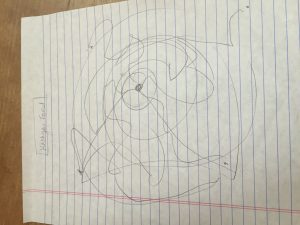
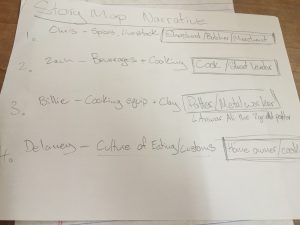
Some productive work we did was on story maps. We discussed multiple story map ideas, like  following the experiences of a traveler leading to a culminating meal, each of us embodying a person along the way, or focusing on a virtual table. We were fond of the first idea, but decided that it would limit our ability to highlight histories and processes that the traveler themselves wouldn’t experience. Therefore we thought it would be really intriguing and unique take on the persona of “middle-men” in Kashgar.  To keep to his research themes of spices and livestock, Chris would be a shepherd, butcher, merchant, or perhaps a cycle through all three. Zach would be a cook or street vendor to focus on beverages and cooking. To illuminate cooking equipment, utensils, and clay Billie would be a potter or metalworker. We even found a real 7 year old potter from the region named Anwar Ali!!! And finally to manifest how eating relates to culture and customs I’d be a homeowner, or the one hosting a guest.  As for the table idea, Billie suggested that we make the table holding our meal the focal point of our map, and zoom out from each dish to our respective research.
Here’s our expert sketches and ideas:

Tentative Story Map
Tentative Story Map

Roles
Roles

Our narrative ideas are currently limited by our lack of knowledge of the StoryMap site. We’re not sure how much information we can place at one point, or how the different points link together. Luckily we’re going to have a class session on it soon.
The final update is that we’re planning to meet weekly at 9:00 on Mondays, to keep a consistent schedule.
Hopefully that was coherent enough to communicate our progress! Thank you for reading!
Regards,
-Delaney

Pho and Focus

Greetings readers,
I hope you’re well!
Tonight has been one of fulfillment, of both stomachs and aspirations. Over pho and other East Asian dishes in local Greensboro joint, the Tongue group bonded and had a chance to converse about life without pressure of impending assignments.
At the outset of this project, I was honestly dubious about the results, and would never have imagined it to have gone as well as it has. Being objectively categorized into groups by interests sounded like a common-sense approach to delineate topics, but when I was categorized into the Tongue group I wasn’t sure that I meshed incredibly well with the other members. Instead of being a random amalgamation of oral-related interests (languages, food, social stratification and roles, etc) it seemed that it was a group of three vehemently excited by cuisine and one only mildly. Within this broad interest, we had group members interested in the rise and falls of empires, the role of women along the Silk Road, and linguistic diffusion. I wasn’t quite sure how we could come to a proposal all members were satisfied with.
Therefore our group was initially very malleable: all our fixations were orbiting around “tongue” aspects, but no one could pin down a topic that equally incorporated everyone.  After reviewing a timeline of nomads in class and being urged to looking into spices by a professor, we loosely decided upon researching spices and the Xiongnu people. However we soon realized that there were very little sources about either of these (spices had substantially more, but not from the timeline we had honed in on), and it seemed like we were just spinning our proverbial wheels. To start over, two members met with Eric and crafted the idea of focusing on the Kashgar region and following a meal.
Within following a meal from the Kashgar region, our team split into four focuses to make a more adequate attempt at gleaning a speck of knowledge on the topic. Christopher is focused mainly on foodstuffs (yoghurt, meat, vegetables), Zachary on beverages (grain, yoghurt, milk wine), Billie on preparation and consumption (utensils, ovens, dishware), and I of the cultural role (etiquette, types of meal settings, cultural diffusion). More specifically, I’m focusing on the customs and traditions behind dining, serving, and consuming.
I’ll admit that I was a mite disappointed when we shifted from a language-focused topic to one of cuisine, but I soon realized it was a blessing in disguise. I love linguistics, but dealing with translations and mapping of tongues that I’m not even remotely familiar with within the confines of this course would have been impossible. Additionally, it’s much more interesting to foray into an entirely new topic than adding to one with a sustained bank of knowledge. I’m actually very intrigued by the cultural concepts behind food, and how food can translate culture in the stead of a shared language. I’ve always found “exotic” food interesting to the palate and the mind, but the way it originated never sparked in my mind as an area of research. While I’m excited to journey into a new area, I’m a little frightened by my lack of expertise. Everyone else in my group can name food documentaries, dishes, and restaurants off the top of their heads, and I sit there enthralled but reeling. I just hope in my unfamiliarity I don’t drag them behind. We had hoped to dine at Apple China tonight but consumed pho instead, I engulfing myself in a cloud of culinary cultural awareness I didn’t know existed outside of cooking shows.
Anxiety-wise, I’m nervous about research and reception. I’m grateful that my topic is probably the farthest removed from the food itself, but am still unsure of how to find sources. I’ve done many collegiate research papers and projects before and can list numerous sources by rote, but absolutely nothing about food. I’m hoping that I can find guidance in the librarians, the professors, and my group members, but I want to be able to stand as an independent entity, not burdening them. Obviously in the time since writing emerged in Asia there must be enough combined sources, but I’m afraid I won’t access them. As for reception, I’m not quite sure of the effect this project will have. Eric urged us to avoid being daunted by this task, because it will only be “a drop in many oceans”, if that, but I still want our project to be original and significant. Through synthesis of established sources I’m not sure how many radical new ideas will emerge.
At the outset I believed that our group was a thrown together group of individuals, but ended up discovering that Zach, Billie, and Chris had all closely bonded freshman year. This naturally made me feel like an outlier, and wonder how the dynamic would progress. In the beginning I think our issue is that we were too polite with each other: no one dared to say no, or shoot down an idea. A contained version of this is fine when brainstorming, but we ended up in a place where we had a myriad of ideas and couldn’t sacrifice any of them. I think we, or at least I, also felt slightly confused working together because none of us were sure what the actual specific outcome of the class was supposed to be. We had meetings to brainstorm and seemingly got nowhere because we couldn’t decide what to hone in on. However after nailing down the topic of Kashgar cuisine we seem to be doing well. Continuing research on dishes to solidify our plan, but slightly coasting, working towards our next deadline. We’ve spent our time tossing around the ideas of tofu raps and food documentaries and interactive website karaoke. I think once we recognized each other as people other than project partners productivity flourished.
Thus far, I would honestly say that my efforts have been more minimal than they should be, at least in comparison to other members in my group. They’re regularly watching food documentaries and seeking additional context, and I feel like I never have much to add. I’ve completed all the required assignments and pulled my weight in suggested research, but haven’t done much additional research. It’s not for lack of interest; I have a dozen documentaries in my queue. Nor for lack of will. More lack of time in a busy schedule. Between four classes, three clubs, three jobs, and applications, I don’t have much free time to explore my own fancies. I think I’m on-par with the expectations of the course, but not actively engaging enough to satisfy my own curiosities or aspirations.
Overall, I’m very excited for the course and trust in team ingenuity. Thank you for reading.
Regards,
-Delaney