We had another Tech Lab this morning in order to go through an introduction to the StoryMap tool. I think that this tool is going to be a great way to illustrate our research projects in a fun, interactive, innovative way. I was really surprised how easy and fun it is to create StoryMaps. The tool was very intuitive—I do not expect a great degree of difficulty from our team members in picking up the basics of this tool. I think my team is relieved to now be able to actually play with the StoryMap tool, which will help to plan the project in a more effective and more detailed way.
What I am most worried about is making sure the citations are accurately attributed to content within the StoryMap. I do, however, think that a larger bibliography page on our class website will be effective.
At this point, I’m getting more and more excited about what these projects will look like in the end. I feel like this process is pioneering a new method of academic research at Guilford and will make our school stand out.
I think the next step is to work on research until we have a basic idea of what each person is saying. From that point, we can figure out how many slides are needed for each person, complete the writing for each slide, find the media for each slide, and organize the citations. I see the last piece of the project being the actual StoryMap data entry. It seems that it will be much easier to organize and edit outside of that tool and that once we begin to enter it, we will probably want to be entering a near-final draft.
Category Archives: Team Tongue
All of the blog posts for the Team Tongue research project.
this week… :/
I have been struggling with creating momentum for my research this week. The combination of other work and some road blocks in research have slowed me down this week in terms of the Tongue Team project.
The two main subjects I wanted to look into this week were the pillow-like oven tools for breaking bread and the stamper (chekish) used to make puncture designs in the naan bread. I expected, since these tools are used today, that there would be a fair amount written on both of these tools. I suppose I was wrong, or I have not found the right kind of search or type of source, yet. I googled “kashgar chekish,” “kashgar naan stamper,” “naan chekish,” “naan stamper,” and came up with mostly recipes and small portions of information on the cooking of naan in Kashgar. While this is fun to read and somewhat useful, I have not found what I was hoping to find: history and cultural influence of these tools. I am slightly disappointed and discouraged, but will try again and shift my focus and search in the hopes of better results.
The Process: 3
Videos, more than anything, have been the most helpful so far. Because we are studying food, seeing the food itself and how people eat it has been a great way to better understand what we’re looking at regarding food cultures and customs. Unfortunately, I haven’t been able to do as much research on my specific topics as I’d have liked. But there has been some great resources that I’m excited to look into once given a free afternoon.
Hopefully that afternoon can be tomorrow and I’ll have more substance to put into a blog post. Until then…
Fall Break: So Close Yet So Far
I am definitely feeling the stress this week. The 3-hour time expectation for the Map Test was a very conservative estimate. I’m struggling to keep up with three very reading intensive classes this semester (two Religious Studies and one Philosophy) at the same time and am finding it near impossible to keep up. I’ve been sick on and off for the past couple weeks, which has put a significant strain on my work time, and am facing a very big week in my internship with the Bryan Series, along with a visit from my mother for family weekend and homecoming this weekend. I normally feel that I hit a rut at some point in the semester, but am feeling like it should be much later than this point.
We did a ten-minute meditation in class today to a recording of poem performances, which was very appreciated. I was enrolled in Eric’s class on Buddhist Emptiness last semester, which had a weekly (if not more frequently) meditation component that I am not sure I realized how much I enjoyed until the class ended, the summer passed, and this new semester has started. I would like to get back into the habit of going to the Buddhist Meditation Fellowship meetings to get that meditation in, which I hope will aid in relieving some stress. I would also like to go chat with both Eric and Jill (my other Religious Studies professor) sometime within the next week to work out some strategies for coping with the high level of reading that is currently on my plate.
My experience in Guilford’s Religious Studies department has been very different than my experience in the Business department. In the Business department, if I did not excel at assignments, it was often because I found the assignments to be mostly busywork and had difficulty motivating myself to complete them to the best of my ability. In the Religious Studies department, I feel a lot of pressure to perform well in my classes because not just because the material is interesting and in depth, but also because I truly look up to and respect these professors and consider them good friends. I feel like I’m not only letting myself down, but them down as well when I don’t complete work to the best of my ability. I’m finding myself spread so thin that I’m not satisfied with my work in any class and then I just end up spiraling into a zone of stress where I can’t finish all of the work and I’m not happy with the quality of the work I am doing so then I end up more stressed and left unable to complete a bigger chunk of what is assigned.
This semester, I am a TA for two different classes, following my summer position as an Orientation Team Leader and my simultaneous work as an intern and student representative for the Guilford Bryan Series. I feel that all of these roles have left me in a place where I feel like I need to be someone that others can look up to and count on and when I start to fall behind, I feel that I am no longer doing that duty. I start to feel like a phony being the TA of a class that I am not thoroughly completing every reading for because I am supposed to be setting an example.
Although this was more personal than I initially intended this blog post to be, I am feeling better just having had the opportunity to talk about it, so I suppose I owe you a “thank you,” kind Internet reader. I hope that your week is a little more positive than mine and I look forward to bringing you a more positive outlook soon.
(Kashi)-ing Up to Kashgar: Recipe for Success
Gute Nacht,
Mind-blowing fact: the correct spelling for a clay oven in the Kashgar region is tandyr, not tandoor. (Many thanks to Zach our research will be much more successful now!!)
The latter portion of this week I spent my time poring over “Silk Road Cooking: A Vegetarian Journey” by Najmieh Batmangli, which is on loan from Jilly of Team Heart. It’s been valuable for my role of discovering the cultural mores and histories surrounding a meal in Kashgar. I’ve learned about casual cafes known as lokantas, the encyclopedia of plants the Chinese once kept for medicinal purposes, the expectation of citizens to be discerning of cuisine and wine, the two constituents of a balanced meal (fan/grain and ts’ai/vegetables or meat), the importance of the least refinement of ingredients possible, and the link between joy and consumption. To a lesser degree of importance, it provided me with many delicious recipes the Tongue Team could use in our final presentation. I probably spent an hour just flipping through and bookmarking dishes I wanted to try, from salads to candies, but the probability of any of them coming to fruition depends on our supplies and cooking skill.
On Friday Tierney lead us on a tutorial of Shared Shelf, a place to share metadata for all artifacts/data/articles/photographs we use in our project. I knew what metadata was before (data that describes other data, like the publishing information on a book) but didn’t have a term for it until then. This resource will be incredibly helpful when trying to collect citations later on. Eric suggested that one person in the group volunteer to enter all the data into Shared Shelf so all four of us don’t have to fool with it, and as Recorder I believe it should be my place, but the Tongue Team seems content to enter data individually for now.
With my insights from the cookbook, Billie’s progress through Youtube videos, Zach’s revelation in terminology, and Chris’s continued research, we seem to be progressing well!
Off to continue working on my first Map Test…………………………….
Thanks for reading!
Regards,
-Delaney
YouTube videos & bread
This week I watched a bunch YouTube videos. The first one I found was about the different kinds of traditional breads that get baked in this really incredible earthen oven: https://www.youtube.com/watch?v=39bRJSUewNE. While the actual baking of the bread by the professionals and watching how everything gets done was fun and illuminating, the three men leading this video expedition were very annoying and would have ruined the video for me if not for the delicious bread I got to watch. This initial video led me to others, all in Mandarin. My favorite so far is https://www.youtube.com/watch?v=cJM38DtTCkk. What I hadn’t realized before this, is that so much information about cooking, cuisine, and traditions surrounding food in Kashgar would not always be documented in the usual ways we expect: scholarly journals or even official/trustworthy websites. Instead, much of the details that I, as well as my group, am so interested in learning about can be found in more creative and personal ways of documentation. Watching three YouTube videos gave me more information than all of the other research I had done through databases and google searches thus far.
Being somewhat familiar with Mandarin, I was able to pair the visuals with the spoken content to an extent. However, the truly enlightening part of watching videos as a source of research is actually seeing everything get prepared and cooked, such as the ways in which they rolled the dough or pierced it with these decorated tools that create beautiful designs in the bread. I now know how the bread gets slapped into the sides of the earthen ovens with pillow-like tools and how the naan sticks to the sides to bake. I now know that the bagels in Kashgar don’t have a hollow middle (like the hole in bagels we have here), but just a dip in the middle. I now know that in tea houses, 茶馆, they dip the naan in their tea and drink out of beautiful white porcelain. In Kashgar they also spread chili sauce onto the naan or tear the naan into pieces and put them into soup/broth.
I have so many new avenues of research to explore that I might never have known existed or were important before now. My next main foci for research will be the clays and earthen ovens/pottery, porcelain, the pillow-like oven tools, and the decorative piercing tools for naan. Additionally, I hope to find more YouTube videos to explore.
~ Side note: these videos, similar to 舌尖上的中国, give me such immense joy. They are so beautiful and fun to watch. Watching these videos held two educational components for me: research and the practice of my Chinese listening and reading (subtitles). I forgot so much Mandarin, but I also gave myself too little credit for how much I do remember; I was able to recognize significantly more characters than expected. ~
The Process: 2
Marco Polo was an intrepid fellow.
I’ve been reading many of his accounts that follow his journey along the silk road to get a better understanding of what the terrain, people and other features were prominent during the time. Polo, who traveled with his father (and initially some priests which were sent along to convert pagans), speaks about the land and the people of places he visits. He seems to have an incredible talent for linguistics and grasps many of the languages of the people whom he interacts with.
He is also more curious than afraid. The priests who I mentioned above, took off when they heard that the next city had been invaded by a ferocious army. Honestly, from the accounts, Polo doesn’t really seem to care. He and his father (Nicolo) are hoping to arrive at the Great Khan’s court before he dies, so they keep trudging along from Baghdad to Hormuz.
Along the way down the Tigris river, Polo talks of a new “breed” of people who are inhuman in nature and acted like wolves. The Kurds were of course just normal people, who happened to be attacking Marco and his party. The fact that he describes them as “the savage and vindictive race who dwelt in those fastnesses, and whose occupation it was to rob and murder,” doesn’t really give them a great rap. Unfortunately, we don’t know what the Kurds thought of Polo and his party of flashy armor, strange amulets and terrifying weapons…
This just reminds us of the fact that having a written language and keeping records, skews the perspective of history toward the victor (and often the European). The Han Chinese wrote about the Xiongnu pastoralists in an uncannily similar manner, calling them “Barbarians and animals from the North.” Quite interesting how the “opposition” is related to animals, both from the Han China and Italian point of view.
After a few paragraphs dedicated to insulting the Kurds, Polo finds himself in the port-town of Hormuz. He then proceeds to insult the Persian ships docked at harbor. I judgmental character to say the least… However, not all is bad. Setting out from Hormuz, Polo remarks on the beauty of the natural landscape with in all its flowering magnificence. In fact, he spends the same amount of time discussing the nature around him as he spends describing an attack in which he and his father had to kill 3 bandits before barely escaping with their lives!
The trails of the silk road are already proving treacherous for our venetian explorer. Will he make it to the hall of the great Kublai Khan, or will he succumb to the dangers of the barren deserts? All will be revealed next week. Until then, a great quote from our drama king:
“(Polo and his squad) leading their horses and camels, sometimes on a path so narrow and so high above the gorge by whose side it ran, that it seemed inevitable that the travellers would fall and break their necks.”
Charming.
(Kashi)-ing up to Kashgar: Developing Stages
Buenas noches,
Hope you’re doing well!
Just imagine: flower-pot tandoor, homemade naan, first person narrative, interactive table, beautiful spiraling maps.
This is a sliver of the creative ideas the Tongue group has fabricated. Since bonding over food we’re feeling much more comfortable around each other and more open to brainstorming ideas.
Zach is still developing his idea to make a cheap tandoor oven. Apparently the cheapest way is about $200, but that’s still too much for our budget. We’ve discussed getting a club, perhaps the Asian Cultures or International Club, to sponsor the project and then donate it to the college. I’ve personally thought of cooperating with the Bonner Food Market or the Farm in some way..perhaps they could incorporate a tandoor into their efforts to diminish hunger. We want our final presentation to coincide with a meal that we prepare ourselves, with fabulously timed tea pouring skills.
Thus far, we’re all slightly frustrated. We’ve done research and brainstormed ideas, but feel as if we don’t know the destination to hone in on. We’ve done loads of research, but feel like it’s not making much progress towards our goal. Even after the sessions with Rachel I’m still slightly overwhelmed by the myriad of sources, but plan to meet with her to narrow them down. Additionally Eric’s and Zhihong’s remarks about unapologetically honing in on a narrow topic, as long as you discuss that there are other factors and topics left untouched, are valuable.
I feel like the whole group is stuck in a limbo where the deadline simultaneously feels far away but the work feels urgent.
Some productive work we did was on story maps. We discussed multiple story map ideas, like following the experiences of a traveler leading to a culminating meal, each of us embodying a person along the way, or focusing on a virtual table. We were fond of the first idea, but decided that it would limit our ability to highlight histories and processes that the traveler themselves wouldn’t experience. Therefore we thought it would be really intriguing and unique take on the persona of “middle-men” in Kashgar. To keep to his research themes of spices and livestock, Chris would be a shepherd, butcher, merchant, or perhaps a cycle through all three. Zach would be a cook or street vendor to focus on beverages and cooking. To illuminate cooking equipment, utensils, and clay Billie would be a potter or metalworker. We even found a real 7 year old potter from the region named Anwar Ali!!! And finally to manifest how eating relates to culture and customs I’d be a homeowner, or the one hosting a guest. As for the table idea, Billie suggested that we make the table holding our meal the focal point of our map, and zoom out from each dish to our respective research.
Here’s our expert sketches and ideas:
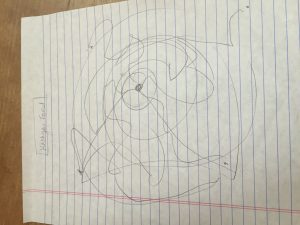
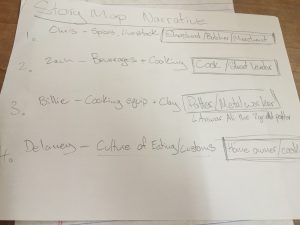
Our narrative ideas are currently limited by our lack of knowledge of the StoryMap site. We’re not sure how much information we can place at one point, or how the different points link together. Luckily we’re going to have a class session on it soon.
The final update is that we’re planning to meet weekly at 9:00 on Mondays, to keep a consistent schedule.
Hopefully that was coherent enough to communicate our progress! Thank you for reading!
Regards,
-Delaney
Post-meeting reflection 9/20
Last night our group met, because we now meet every Monday night (this week at 7:00, every week in the future at 9:00). We discussed what we had each done up to this point, which, to be clear, has been minimal for all of us. Zach is stoked about Tandoor ovens and Youtube videos about making them as well as videos on street food and other meals in Kashgar. The rest of our research seems to be rather hard to progress with. Delaney and I were talking about how there seemed to be some stuff to read, but that nothing felt valuable or felt like progress. There are very few books about the history of Kashgar, let alone food or culinary practices in Kashgar; the research on Kashgar I have done in various databases is also fairly limited and feels like context rather than the content we hope to have in our project. I have had slightly better luck zooming out to Xinjiang and hoping to find specifics about Kashgar within. My next step is going to be expanding my search to google and not just databases. I am hoping to sift through websites and any other results that might pop up form google searches either today or tomorrow (9/21). Ideally I would like to be spending at least 30 minutes to an hour every day on research for the Tongue team and I am hoping to attempt to accomplish that minimum this week as a trial run and see how successful I am. As a reminder to myself and a statement that might help keep me accountable for fulfilling this: I need to create a more thorough and upgraded timeline for my group as “timekeeper”.
The largest part of our meeting centered on how we were going to make a narrative out of our separate parts of the whole Tongue Team project. This led us to the question of how we wanted our portion of the map to look like and how it will travel from point to point. I was envisioning a picture of our meal as our main point and then have the ability to click on each aspect of the table in order to bring you to the background of each component of the meal. I don’t know, technologically, if that is possible, so we also discussed how the traditions of the order of what got served or eaten first might help us with how the digital map travels from point to point. We discussed a lot of ways in which we could turn our project and all its facets into a map for the final project. It was really fun to think of that creative aspect of the project and to look ahead at what it might look like when it’s all said and done.
Monday Meeting Debrief: How to Create a Linear Narrative with Many Different Elements
Last night, I met with my group in the library to set up a basic plan of attack for the next few weeks. We talked about how setting up specific data finding/creation deadlines to make our group progress schedule a bit more specific. As per Eric’s advice, I recommended adding deadlines for having all of the images, all videos, all text completed, etc. as we anticipated that data entry will take longer to finish than groups might think at this point.
In our administrator meeting yesterday morning, we discussed that each team will only be allowed to use one single StoryMap to present the work of their entire team, rather than creating multiple maps for different sections of the project. I think this will be particularly daunting for my team since we don’t necessarily have one singular storyline, but one meal that traces out in multiple lines in different directions since they are tracing different ingredients and elements of the meal backwards through time. We made a lot of progress in imagining how our StoryMap will actually end up by drawing out different formations while brainstorming. The best idea that we came up with was to create a center point with the image of the entire meal and take each element, in order of their consumption throughout a typical meal period (starting with drink, first course, second course, etc) and then zooming out to the beginning of the history of that element and tracing it back to the table and overall meal. By tracing inward rather than outward, each element will end at the center and refocus on the larger picture of the entire meal. We will then proceed to trace the next element from the outer-most point inwards and so on. This will make the phases of the project seem almost like flashbacks that lead the reader to the final meal.
We talked about how we will maintain a narrative within this format. We had originally envisioned telling the story from the first person perspective, allowing one person to witness where the ingredient came from and they got it to the table. We also brainstormed telling the narrative in the first person as the ingredient itself. We came upon a final solution of telling the story in the second person perspective, allowing the audience to be the center of the narrative and having them be the person bring the ingredients to the table. This will create a narrative that seems almost like a “choose your own adventure” novel, but structured to be a directed story rather than a number of audience choices.
I was worried that the limited format of StoryMap would limit our narrative abilities, but I think that we have come to a very good agreement and new arrangement for our information. At this point, my team is feeling anxious to learn about the StoryMap tool and is eagerly counting down to our next Tech Lab.