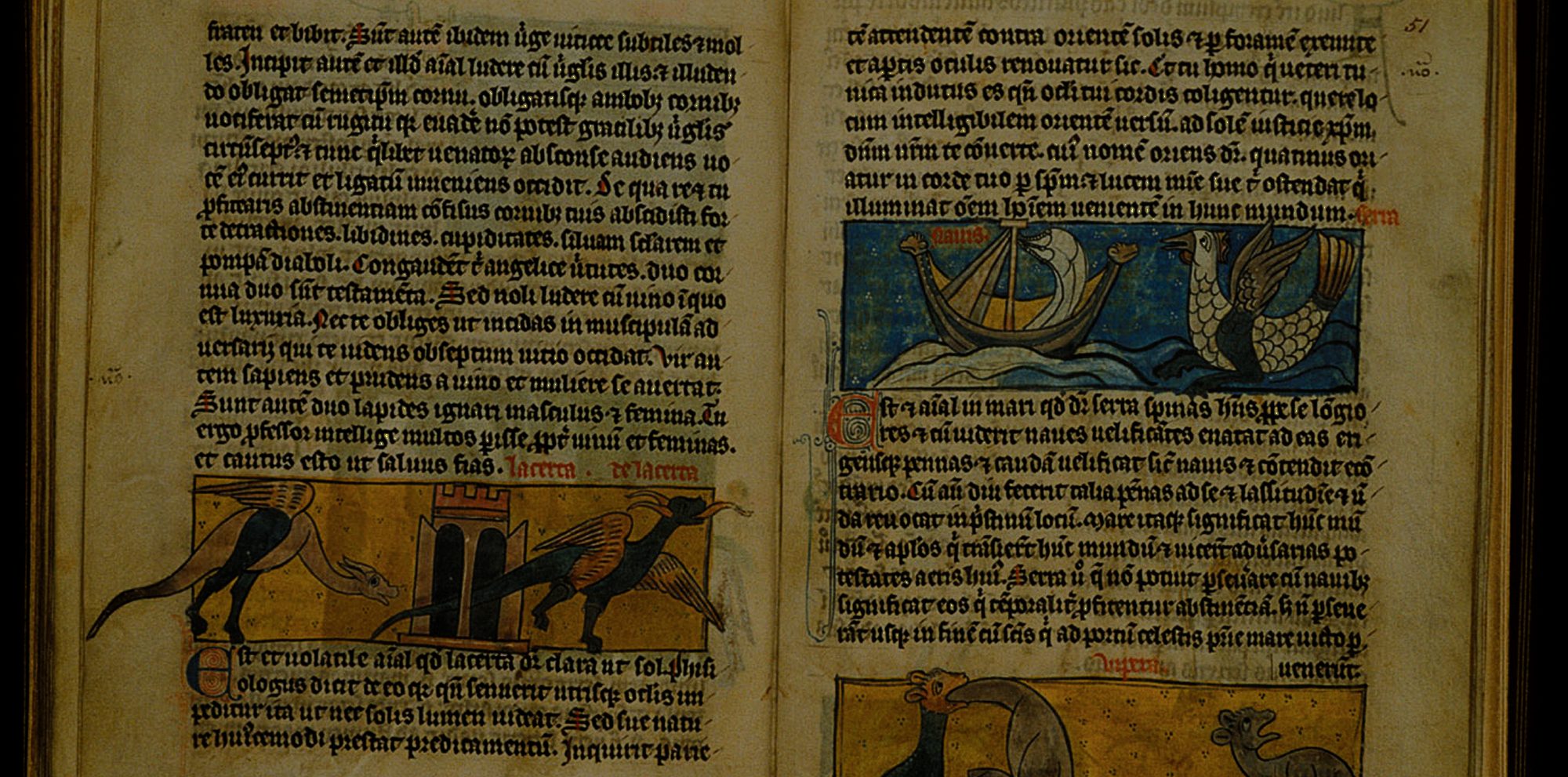
This Digital Bestiary was created by Guilford College students in the Religious Studies course REL 288: Defense Against the Dark Arts, taught by Eric Mortensen (Associate Professor of Religious Studies) and Tierney Steelberg (Digital Pedagogy & Scholarship Technologist at Hege Library) in Fall 2018.
We would like to express our thanks to Guilford College’s Faculty Development program, Hege Library, and the course Teaching Assistant Lee Allen.
Course Description

The course examines the religious roles of witches, ghosts, and demons, monsters, dragons, and other odious beasts. It is also, fundamentally, a course about death, dying, the fear and anxiety surrounding dark, the “other,” the night, and death, and the problem of evil. We employ a comparative methodology to examine (typically) nefarious spirits and beings as they are understood in various contexts around the globe. Our focus on witches, for example, includes attention to the religious traditions of Europe, West & Central & East Africa, and Southeast Asia, our investigation of ghosts focuses primarily on the traditions of the Japanese and Yi (the Nuosu people of Southwest China), and our study of demons and demonology primarily addresses both Tibetan and European sources. Nevertheless, the scope of the class is not strictly limited to these specific religious traditions, rather, we include mention of similar horrors elsewhere, including the contemporary U.S., and discuss such beings as vampires, devils, goblins, cryptids, lycanthropes, etc., although the local names of such creatures vary greatly. Topics we address throughout the semester include, among others, the role and classification of “evil” in different cultural contexts, the roles of magic, occult, and the supernatural in the face of an increasingly empirical modern and postmodern world, the importance of death and un-death in various religious traditions, and the methods we, as scholars of the history of religion, employ in the comparative investigation of religious phenomena. At heart, this is a class about fear. This course is also a laboratory in the Digital Humanities, wherein students engage in collaborative comparative research projects and design digital products that are housed on this course web page. Some of our class periods are tech labs, wherein students learn digital skills that they bring to bear in their collaborative research. This course fulfills the Humanities requirement at Guilford, counts toward a Major or Minor in Religious Studies, and counts toward a Minor in Medieval ~ Early Modern Studies. This course also fulfills the Intellectual Curiosity requirement at Guilford College, which all students must complete in order to remain human.
