Introduction
Dragons and nāgas, two reptilian-like creatures, the former of which has captivated the imaginations of the human mind for millennia and across various places and cultures. Although some dragon scholars open their works with the statement of, “No dragon exists- none ever did” (Ingersoll, 1928) or the similar claim of, “Dragons do not actually exist-none ever did exist” (Zhao, 1992) their pervasiveness across the collective consciousness of humanity across various times, places, and cultures attests to the dragons importance in the mythological realm.
Things become a bit more complicated when one considers the various serpentine creatures also classified alongside the category of the dragon, not to mention the tendency to compare the Eastern traditions of the dragon to that of the Western variety. Although this is a route undertaken by past draconic scholars in this study we wanted to avoid such comparisons as even though the topic of dragons is a wide and fascinating one, to do so under comparisons of Eastern and Western traditions runs the risk of imposing Western biases onto Eastern traditions, which is not the goal of this research. Rather we wished to bring our focus onto the Chinese region due to it’s rich traditions in dragon lore and as a means of examining how the arrival of a new religion (Buddhism) into the region affected the already prevalent tradition of dragons as a motif of Chinese imperial power. There is also much to be said of how both the traditions of the Chinese dragon and Naga hold associations with water and how this key ability influenced their iconography within their respective traditions.
A Brief Timeline of Nagas and Dragons
Iconography and Oral Descriptors in China
“The dragon is as old as the sensitivities and imagination of mankind, and doubtless had assumed a definite shape in some crude, material expression as long ago when men began to paint, or carve in wood and on stone…”
(Ingersoll, 1928)
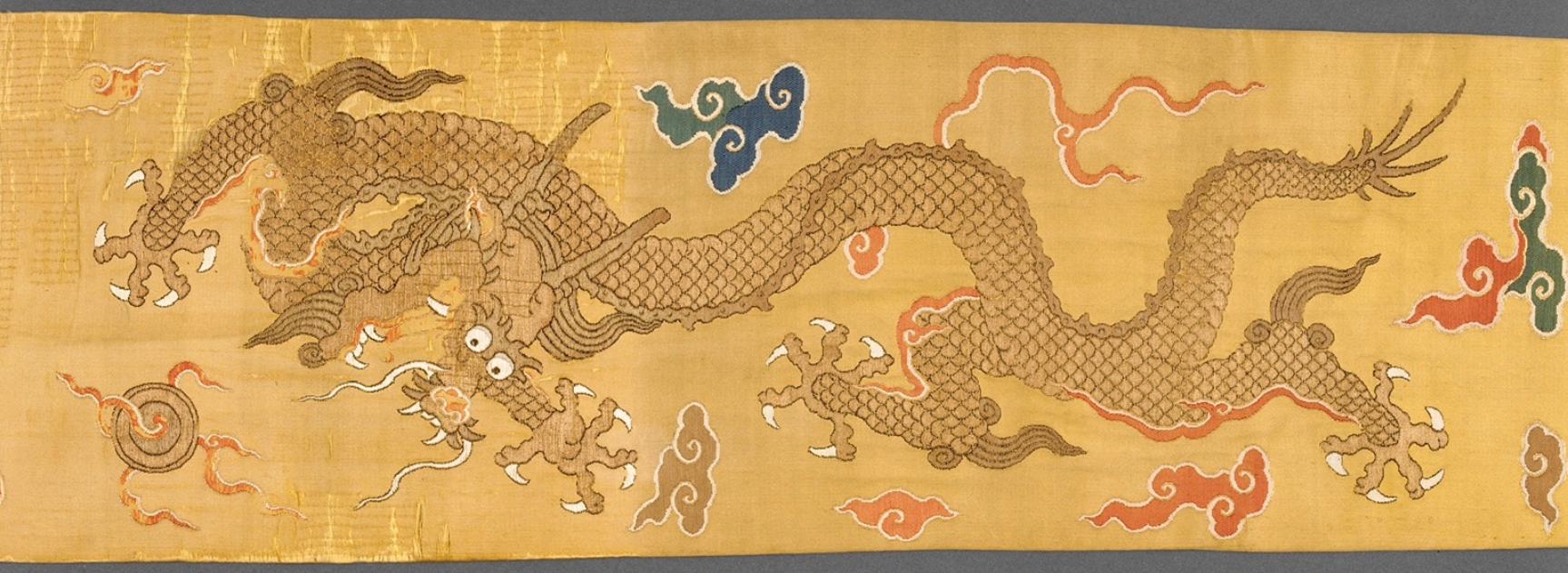
For as long as people envisioned the dragon, a few key iconographies an motifs would appear in frequent amongst the artistic and cultural depictions of dragons. The motif of the dragon chasing the pearl across the sky is common, as is the image of the dragon amongst rivers and rainclouds.
As for the nāgas they were frequently described in that, “they may be found represented even as men or women with snakes coming out of their necks and rising over their head” (Ingersoll, 1928). The depiction of nāgas as serpent creatures were frequent especially in the region as the image of a serpent was common in invoking supernatural of divine traits, as with the Imperial dragon being serpent-like in figure.
The Chinese dragon was in a sense a chimeric creature in that descriptions often involved the amalgamation of various animals and their subsequent parts.
Regionality
While the exact origin of the dragon myth remains contested amongst scholars, their arrival into Chinese tradition sprung around the
The nāga is in truth a pre-Buddhist entity as first appearances were noted in early India, back when the region was primarily focused on agriculture. There even existed a people in the region known as the nāga people whose presence in the Hindu valley region eventually
Roles in Religious Tradition and Cultural Aspects
From this point the Chinese dragons relationship with Imperial power has been established through centuries of dynastic tradition. Meanwhile as mahayana Buddhism began to take prevalence the Chinese region scholars began to see the migration of the Naga story as the guardians of Buddhism shifted into China from their Indian origins.
Dragons, Naga, and Religion
Dragons and Divinity Status
There exists an interesting tale recorded by the the Chinese traveler Fa-Hua in 400 A.D. which recounts, “A white eared dragon is the patron of this body of priests. He causes fertilizing and seasonable showers of rain to fall within this country, and preserves it from plagues and calamities, and so causes the priesthood to dwell in security. The priests in gratitude for these favours have erected a dragon chapel, and within it placed a resting-place for his accommodation… At the end of each season of rain the dragon suddenly assumes the form of a little serpent both of whose ears are edged in white…He makes his appearance once every year” (Ingersoll, 1928)
Defense Against Dragons and Nāga
The Thing About Chinese Dragons:
An interesting thing about the Chinese dragon is that while their narratives differ from their Western counterparts there still exist stories of dragon-slayers in the Chinese tradition. The thing to keep in mind is that such tales of dragon-slayers are kept within the realm of folklore rather than myth or legend. This is due to how folktale is generally regarded as fiction and are not rooted in dogma, whereas, “Chinese dragon myths are an embodiment of dogma; they are usually sacred and often associated with the rise and fall of a dynasty, especially a remote one. The Chinese mythological dragon, which cannot be slain, displays only esoteric implications” (Zhao, 1992). The mythological dragon is in a sense untouchable by slayers as the dogma associated with the dragon stems from Imperial power, so to slay the mythological dragon would be unthinkable as it would mean rebellion against the emperor.
Traits of a Dragon Slayer:
It is said that, “dragon slayers are usually lonely people” (Zhao, 1992) which makes sense as to take on the endeavor of slaying a dragon would require one to distance themselves from others in an attempt to seek out the dragon.
Bibliography
Zhao, Qiguang. Study of Dragons: East and West. New York: Peter Long Publishing, 1992.
Ingersoll, Ernest.Dragons and Dragon Lore. New York, NY: Payson & Clarke, 1928
Ollivier, Thierry. Banner with Dragon. 1662-1722. Réunion Des Musées Nationaux (RMN), Musée Guimet, Paris, France. Accessed December 6, 2018. https://library.artstor.org/#/asset/ARMNIG_10313260071.
Page written and created by Cynth T. and Laura S.
