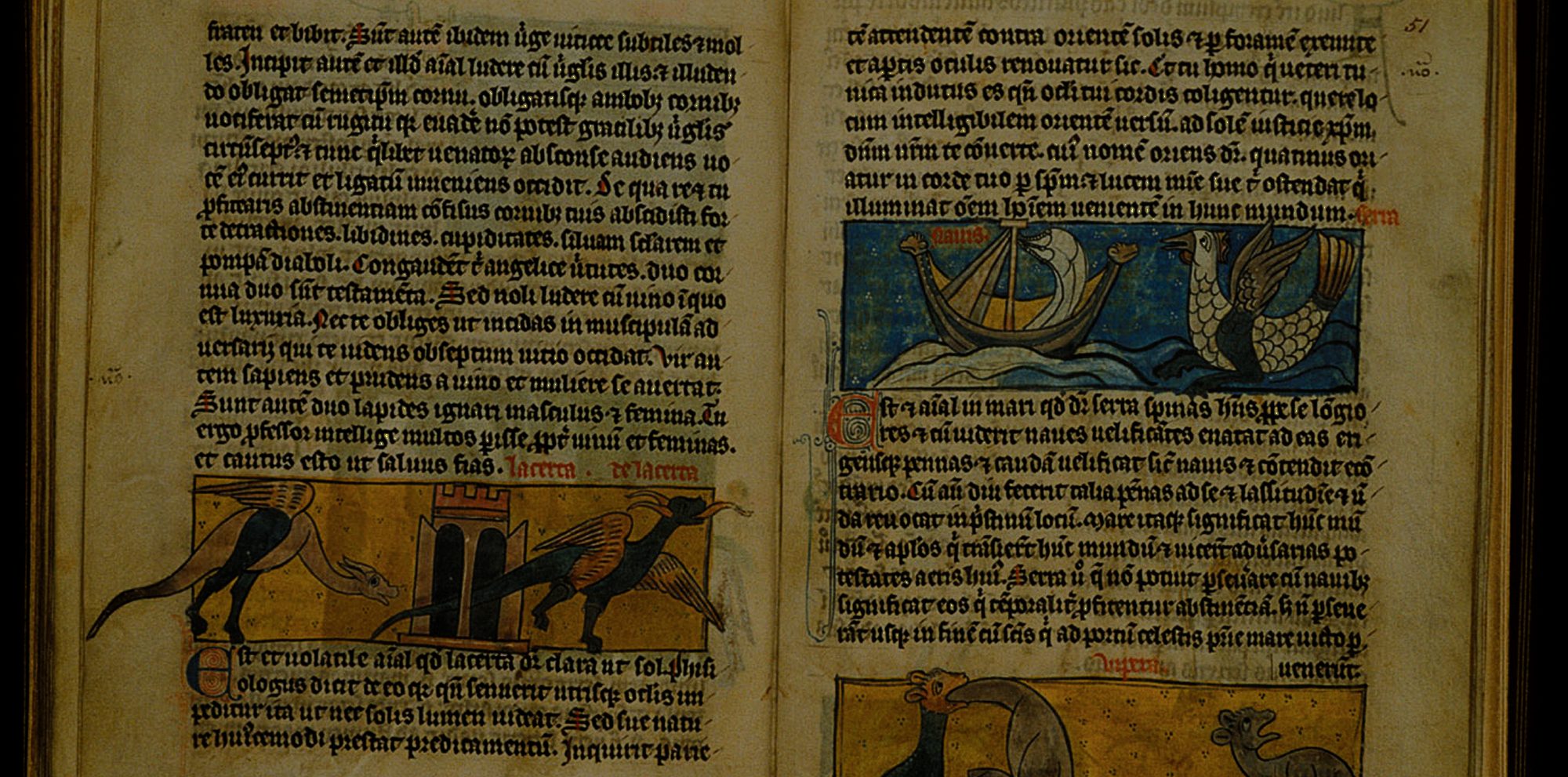
A brief list of additional bestiaries from around the world.
Richard Strassberg’s A Chinese Bestiary
Strassberg, Richard E. 2002. A Chinese Bestiary : Strange Creatures from the Guideways through Mountains and Seas = 山海經. Berkeley : University of California Press,.

A Chinese Bestiary edited and translated by Richard E. Strassberg provides a series of woodblocks and plates of etchings of various beasts within the Chinese culture and surrounding religious beliefs. The prints are accompanied by descriptions of the creatures shown, as well as offerings of many more not pictured. The Bestiary provides Chinese measurements for map translation (also included in the book), important dates, and the history of dynasties dating all the way back to ancient times.
The Medieval Bestiary: Animals in the Middle Ages
“The Medieval Bestiary.” n.d. Accessed November 2, 2018. http://bestiary.ca/.

The Medieval Bestiary: Animals in the Middle Ages, a website designed and owned by David Badke is the home to an extensive repertoire of beasts of all sizes. The site provides a lengthy list from A to Z, some being more mundane and others absolutely extraordinary. Accompanying this list are classifications of each animal, as well as their common or more specific names. An explanation of Bestiary Families is also given, with an extensive bibliography to follow.
Weird and Wonderful Creatures of the Bestiary
“Weird and Wonderful Creatures of the Bestiary – Medieval Manuscripts Blog.” n.d. Accessed November 2, 2018. https://blogs.bl.uk/digitisedmanuscripts/2014/06/weird-and-wonderful-creatures-of-the-bestiary.html.

Weird and Wonderful Creatures of the Bestiary is a page of a more extensive blog entitled Medieval Manuscripts created by a woman of the name of Sarah J Biggs, held on the British Library’s website. Various hand-drawn and painted pictures of very spectacular and rare beasts can be found on the page including: the Amphivena, the Manticore, the Bonnacon, the Leucrota, and the Basilisk. Under each creation is a short yet precise description of the stated beast.
The Aberdeen Bestiary
“The Aberdeen Bestiary | The University of Aberdeen.” n.d. Accessed November 2, 2018. https://www.abdn.ac.uk/bestiary/.

The Aberdeen Bestiary is an 800 year old book that has recently been posted online for the public to access. This ancient and fantastic book is one of the oldest of its kind and can be found at the University of Aberdeen. The book is filled with paintings of animals and biblical stories that illustrate tales of moral behavior. The book is opened with the Creation Story from Genesis, letting the reader in on the creation of each animal. Lavish hand painted pictures encrusted in gold leaf mark almost every page. On the opening pages, the story of Adam and the gifting of the animals with Hebrew names is described and visually depicted. The Bestiary focuses in on what it considers to be real beasts (lions, panthers, tigers, wolves, foxes, dogs, apes, and all others who vent their rage with tooth and claw), with an intensive focus on the lion in relation to its depiction as Christ. Through the University’s website, photocopies, commentary and translations can be found.
T.H. White’s The Book of Beasts
“The Book of Beasts.” 1960. http://digicoll.library.wisc.edu/cgi-bin/HistSciTech/HistSciTech-idx?type=header&id=HistSciTech.Bestiary&isize=M.

T.H. White’s The Book of Beasts explores three categories of creatures with Christian tales intertwined through the whole thing, translating the tales of old Medieval beliefs. Beasts included lions, leopards, tigers, wolves, foxes, dogs, monkeys, and others which about with tooth and claw. Snakes were also considered to be beasts due to the violence with which they rage, and are commonly known as wild. Birds represent those that do not follow straight roads, but stray through and byway. Reptiles and fishes are also described as a category of creature. Serpens dominate the reptile category though do not completely belong in it. A serpent creeps by secret approaches and not by open steps. Draco (or dragons) are said to be the biggest of all serpents. Those serpents with four legs are considered to be reptiles. Additionally, fish get their name because they browse in flocks. Oddly though, fish are too considered to be reptiles due to their same shape and natural disposition for swimming about.
Richard De Fournivals’ The Bestiary of Love
Leach, Author Elizabeth Eva. 2013. “Richard de Fournival’s Bestiary of Love.” Elizabeth Eva Leach(blog). September 12, 2013. https://eeleach.blog/2013/09/12/richard-de-fournivals-bestiary-of-love/.
The Bestiary of Love by Richard De Fournivals was written to win the favor of an unnamed woman who was resisting his advances, often bound with musical material. The piece was a combination of courtly love literature and a bestiary, the first of its kind ever seen. De Fournivals would speak of the nature of an animal and how it related to loving a woman:

“The nature of the wolf is such that when a man sees it before it sees the man, the wolf loses all its strength and courage. If the wolf sees the man first, the man then loses his voice so that he is speechless. This nature is found in the love of a man and woman.”
Followed by a seemingly uninterested response from the woman:
“I must truly say that I was seen first by you whom I must for this reason call the wolf. For it is with difficulty that I can say anything to counter your words. Wherefore I can truly say that I was first seen by you, and I must thus be on my guard if I am prudent.”
This would be a good source if looking for unconventional comparisons and definitions of various yet common animals.
